
Chapter Text
✦ --- ✦
✦ --- ✦
Vincent had redrawn the circle three times.
No.
Five.
No, that was a lie.
Nine.
Just that day.
The first time, because the chalk had been ground poorly and left an uneven edge on the outer line. The second, because one of the inscriptions leaned ever so slightly to the right —less than a centimeter, perhaps less— but it was enough to irritate his eye every time he lifted it from the diagram on the floor.
The third was worse.
He had gone still in the doorway, watching it in silence, and understood that the whole thing was breathing wrong. He did not know how else to explain it. The circle closed. Yes. It was precise, almost impeccable. But it was not balanced. Something in the distribution of the visual weight sagged to one side, like a badly calibrated machine, like a structure that still had not quite settled into itself.
The fourth time, a drop of coffee fell too close to the middle ring, clouding the salt.
The fifth, after cleaning it, because he could no longer trust anything he had touched afterward once he had seen it. It got under his skin and he ended up wiping the whole thing away in exasperation.
After that, the exact number stopped mattering.
He reached a point where he was no longer correcting major errors. Not even errors. They were variations. Microscopic unevenness. Unequal tension in a curve. One stroke just slightly thicker than the one before it. A minimal gap between marks. Nothing anyone else would ever have noticed.
But he did.
And if he could see it, then it was there.
And if it was there, then the system was no longer clean.
So he erased everything.
Completely.
And started again from the beginning.
Not out of dramatics. Not for aesthetics. Not out of some lunatic artistic impulse.
But because it had to be perfect.
Not beautiful.
Not impressive.
Perfect.
Now it was right.
Not elegant. Not mystical. Not “close enough” to the scattered diagrams he had torn from old treatises, marginal notes by dead occultists, and two notebooks stolen from a private collection.
Right.
Exact.
Or as exact as he could make it with materials from this plane, a hand that trembled now and then, and more than thirty hours without sleep like any decent human being.
He stayed standing in the threshold, not stepping in yet, running his eyes over it one more time.
Outer ring.
Twelve major marks.
Thirty-six minor ones.
Clean intersections.
No dust dragged between the grooves.
Wax outside the useful boundary.
Salt intact.
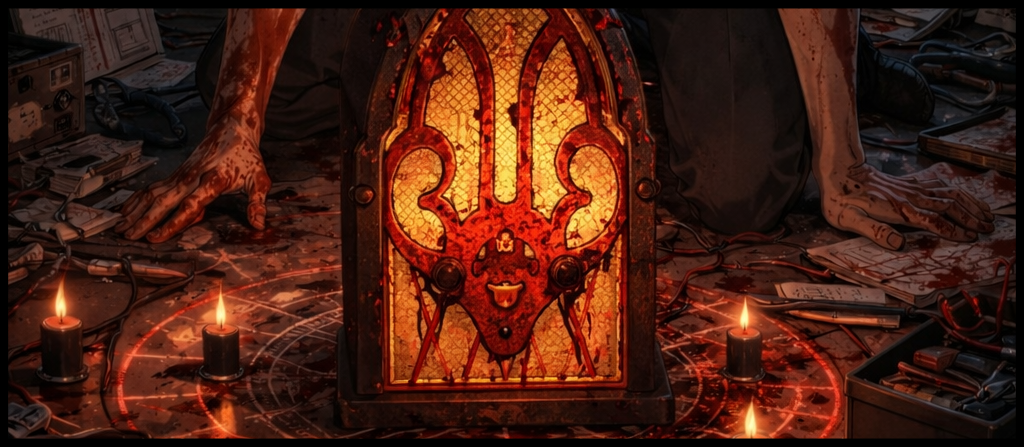
An old radio in the center of the circle.
Wiring not brushing any symbol.
Set to a stable frequency with nothing but white noise.
He analyzed the scene again.
Not because it was necessary.
Because if he did not, if he did not count every single element, the idea that he had forgotten something began to make noise.
And if he had forgotten something, there was no point in going on.
Twelve major marks.
Thirty-six minor ones.
Outer ring intact.
Intersections clean.
Salt with no visible contamination.
Wax outside the useful boundary.
Wiring not brushing any symbol.
Set to a stable frequency with nothing but white noise.
An old radio in the center of the circle.
Everything right?
He counted a third time.
He went over it again without moving from the threshold, as if his whole body refused to step in before his eyes had finished tracing every edge, every gap, every smallest relation of distance between one mark and the next. He was not looking at a circle. He was checking a system. A seal. A mechanism that had to obey him once and for all.
And still he counted again.
Not out of mathematical necessity.
For peace.
For his own sanity.
Because the problem had never been the number. The problem was that exact instant after the counting, when his mind, if he let it off the leash, began manufacturing possible errors. One line a shade thicker than another. A curve pulled too tight. An angle leaning ever so slightly wrong. A symbol drawn well enough, yes, but placed with an almost imperceptible misalignment from the rest of the whole. Nothing anyone else would ever have noticed. Nothing anyone else would have understood. Nothing that would have mattered in a reasonable conversation.
But he would see it.
And if he saw it, then it was no longer clean.
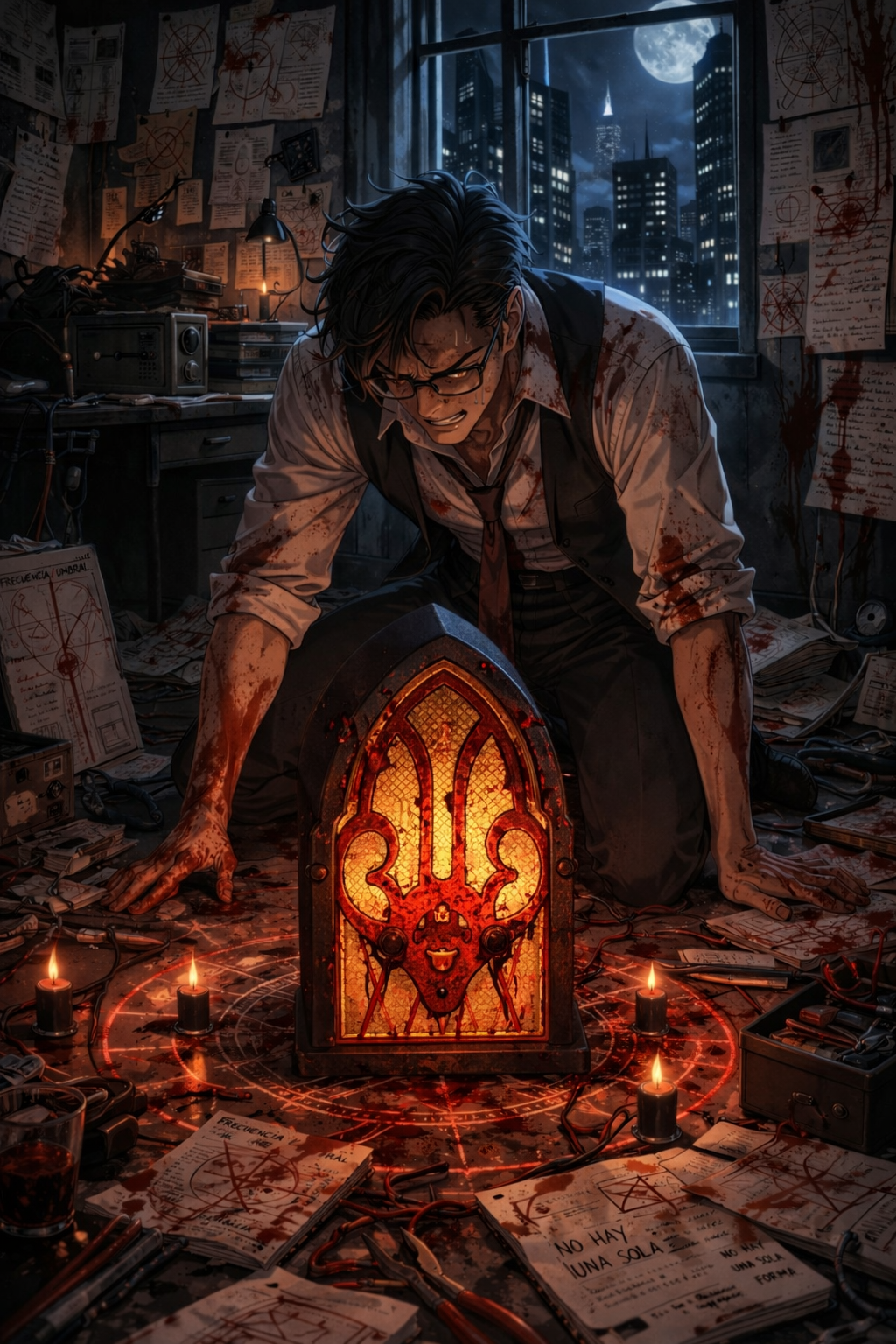
The room had stopped looking like a room a long time ago. Hours, certainly. Days, probably. But the real transformation went farther back than that. It was no longer a rented space with decent furniture, a worktable, a narrow window, and too much paper. It was the visible cavity of an obsession. A place hijacked by something that had been growing for too long without saying its name aloud.
The floor was covered in overlapping diagrams, torn sheets, formulas rewritten over other formulas, columns of equivalencies, failed attempts at translating archaic symbols into contemporary measurements, notes in the margins where Vincent corrected himself with a precision so violent it occasionally seemed personal. There were cross-outs carved so deep they had torn through the paper. Words circled three times in different inks. Arrows contradicting one another. Crumpled pages in the corner, not because they were useless, but because they had become unbearable to look at. Versions that, at one point, had been acceptable for a few minutes, even for a few hours, until suddenly something in them twisted and there was no longer any way to keep them nearby without feeling his eye revolt at the sight.
At the exact center of the circle rested the old radio.
Intact.
The closed casing, the clean dial, the front cloth worn only slightly by time, and that absurd domestic presence that, placed there in the middle of salt, wax, chalk, and marks calculated down to the millimeter, stopped looking like a radio and began to look like something else. Not a device. Not entirely. More like a nucleus. A receiving point. A quiet organ to which everything else in the room seemed to answer.
It was switched on.
It was not broadcasting music.
Not yet.
Only a fine, continuous, steady white noise, held at a frequency Vincent had spent weeks fixing without perceptible variation. It was not a loud or dramatic hiss. Just a flat, contained, almost clinical murmur, as if the set were breathing low and even at the center of the system, waiting.
Added connections ran from the back of the radio with an almost obscene degree of care.
They did not deform the general silhouette of the thing; Vincent had worked far too hard to allow that. The grafts were made to integrate, not to flaunt themselves, and he had protected that piece with a severity far greater than the care he had given any other component in the room. Not only because it was the nucleus of the system. Not only because the entire arrangement had been calculated around its dimensions, its frequency, and its physical presence at the exact center of the circle.
But because that radio was irreplaceable.
It had belonged to the Cannibal of New Orleans.
Not in the cheap sensational sense of gutter newspapers, but in the most concrete, most police-record, most obscene sense of the word. The radio had been found in the cabin in the swamp, among enough evidence to turn the case into a national wound: dozens of human remains, photographs of victims, teeth ripped out and catalogued as trophies, ritual implements, voodoo symbols, and more than enough traces of systematic cannibalism. The subject was never identified. There was never an arrest. No body ever surfaced that might have closed the matter. Only the scene remained. The cabin. The swamp. The remains. And a void so complete at the center of the case that the country eventually remembered it by the only name the headlines had been able to force onto the horror: the Cannibal of New Orleans.
Vincent had known the file long before that, of course. Anyone with the slightest interest in infamous crimes knew it. But for him it ceased to be merely an infamous case the year he decided to turn it into a major piece and ended up producing, until then, the strongest work of his entire career.
It was not easy.
He got access to files no one had intended to open for him. He interviewed retired policemen who had spent years refusing to speak, followed the route through the swamp, visited the abandoned cabin now fenced off and forbidden to the public, reconstructed inventories, spoke to relatives of victims who had in fact been identified, compared versions, cross-checked dates, chased contradictions other people had left buried beneath decades of badly digested morbid fascination, and finally built a documentary so precise, so ferocious, and so uncomfortably well-made that it put the case back in the mouth of the entire country.
For weeks, no one talked about anything else.
The cabin.
The victims.
The teeth.
The photographs.
The intact mystery of the man who never surfaced.
It was not just any television success.
It was one of those rare moments when a piece stops feeling like programming and becomes a national conversation.
The network sold it as one of its most ambitious works; the papers called it brilliant; and, for one of the few times in his life, Vincent felt he had put his hand into something alive. Something enormous. Something that did not merely occupy airtime, but tore through it.
And only then —for having gone straight for the country’s jugular— did people inside the station begin to look at him differently.
It was not only prestige.
It was fixation.
Because the more he worked on that documentary, the more his attention locked onto one particular piece with an insistence he had, at first, no idea would obsess him so thoroughly.
The radio.
It was no minor detail in the case. Quite the opposite. It was one of the most famous objects recovered from the cabin in the swamp; one of those pieces that overtake the file itself and become a phenomenon in their own right. It appeared in inventory photographs, archival notes, reports, television specials, articles about cursed objects, lists of famous criminal relics, always with the same caption, the same provenance, the same morbid charge attached to it.
It had become one of the most coveted pieces in the entire museum. People went to see it. Asked about it. Recognized it. It had that rare sort of fame only certain objects ever achieve when they cease to be evidence and begin to serve as a screen onto which collective fear is projected.
Vincent saw it so many times during the investigation that he ended up committing the smallest details of its casing to memory: the exact tone of the wood, the fall of the front cloth, the slight wear beside one of the knobs, the proportion of the dial, the way it looked beneath the museum glass. He would never have admitted aloud that he had become obsessed. He would have called it professional interest, attention to detail, trained visual memory…
A lie.
He wanted it.
Not as some vulgar collector’s fetish. Not as a morbid whim. He wanted it with the same silent violence with which he had wanted certain things since he was young: first with his eyes, then with his mind, then with the whole inner machinery that could turn sustained desire into a plan.
So he did what he did best.
He studied it.
Got the measurements.
Tracked down enough photographs.
Had a replica made.
Not a cheap imitation, but a meticulous copy, made with the sort of precision that bordered on insult. It took him weeks to find the proper wood, the exact tone of the varnish, the right aging in the cloth, the precise curve of the knobs. He corrected details an ordinary forger would have called acceptable. Redid entire sections over differences measured in millimeters. He wanted the replica to survive a superficial inspection, a hurried inventory glance, even the lazy confidence of someone who had spent years seeing the same object behind the same glass and no longer expected anything to change.
Then he went to the museum.
And he switched them.
No noise. No scandal. He left behind nothing but a replacement good enough to buy him time.
The genuine one was here now, at the exact center of the circle.
That was why he had kept it intact.
The radio remained a radio: closed casing, clean dial, front cloth only faintly aged, original knobs, compact and recognizable in its presence. He had not wanted to mutilate it. He had not wanted to gut it or violate its form. Everything monstrous lay outside it. Everything modified, adapted, and technically aggressive happened around it. New wiring ran from the base and crossed the floor in tightly drawn lines toward a set of metal pieces, adapted valves, altered plates, small cylinders, seals, copper, screws from various sources, and an auxiliary structure that did not fully belong either to a laboratory or to a rite. The radio still occupied the center as a whole object, entire, almost solemn. As though, even in the midst of all that excess of calculation and compulsion, Vincent had needed the heart of the system to preserve a legible form.
And it was not only aesthetics.
During the documentary investigation, after studying police photographs, sketches, inventories, scene angles, and partial reconstructions of the cabin, Vincent had come to a conclusion he could never entirely shake: everything seemed arranged around that radio. Not by accident. Not as if it had merely been sitting there on some random surface, by chance among the remains. No. If one took the radio’s position as the fixed point, the rest of the cabin began to organize itself around it. The trophies. The work surfaces. The ritual remnants. The very layout of the room. Everything acquired a different logic. Almost as if that piece had been the true center of gravity of the place. As if the presumed killer had thought, worked, and preserved that room from it and for it.
And among all the things found in the cabin, it had also been one of the best cared for.
Not the cleanest. Not the most ostentatious.
The most jealously preserved.
To Vincent, that stopped looking like a detail.
It became structure.
And when something became structure, he no longer knew how to look away from it.
Or leave it untouched.
Much less resist reproducing it.
So he did what he always did when an idea stopped being theory and began demanding form: he studied it until it became a system.
And then he remade it.
Not crudely. Not like some vulgar fanatic copying a crime scene for the thrill of it. Vincent would never have stooped to anything that clumsy. What he did was worse. More precise. More intimate. He took the spatial logic he believed he had read in the swamp cabin and transferred it to his own room with the meticulous discipline of a man who was not decorating an obsession, but reconstructing a mechanism.
He placed the center where the center had been.
He arranged the rest from there.
He did not reproduce the remains, or the trophies, or the grotesque theatricality of visible violence. But he did preserve the hierarchy of the space. The obedience of the perimeter. The relation between nucleus and periphery. The sense that everything, absolutely everything, had to exist in function of a single unmoving piece.
The radio at the center.
Everything else around it.
As in the swamp.
As if, by repeating the architecture, he might also repeat the will that had once held it together.
That was, perhaps, the most indecent thing in the entire room.
Not the chalk.
Not the salt.
Not the seals.
Not the wires drawn taut like nerves.
But the fact that Vincent, without saying it aloud even once, had ended up imitating a man he had never known, whose face no one had ever been able to name, and whose absence still rotted at the center of one of the country’s most infamous cases.
An imitator even in that.
It did not look built in stages.
It looked forced to coexist.
As if two hostile languages —one technical, one arcane— had been made to share grammar by force of calculation, sleeplessness, and an obstinacy far too prolonged to keep calling a whim.
It was not the work of a night.
Or a week.
Not even only of those recent months when the obsession had become all but impossible to hide, leaking into the office, into his schedule, into the abrupt tone with which he ended calls, into the few conversations he still tolerated, and into the way he kept staring at certain objects as though each of them concealed one more piece of the mechanism.
He had gone on having a life, of course.
Work. Schedules. Meetings. Broadcasts. A tie. A functional smile. The station. The documentary. Promotions that never came or came too late. Small professional victories that, from the outside, could still pass his existence off as that of a busy, ambitious, perfectly recognizable man.
And besides that, the social life that never quite died: bittersweet Christmases, family dinners held together more by inertia than affection, obligations where he still had to look proper, whole, available. The persistent presence of his ex-wife. Her family, still tied too closely to his by years of familiarity, habit, and friendship. That entire world kept demanding manners, time, and appearance. Vincent did not stop living it. Rather, he learned to let one visible life keep moving on top of another.
He had begun to live with his body divided between two worlds: the visible one, the routine one, the one other people could see and name without difficulty; and the other one, this one, which could not be seen from the outside but kept gnawing at his thoughts from within with machine-like patience.
He had become the sort of man who did not withdraw from the world to devote himself to a rite, but the sort who kept functioning while rotting in parallel.
The idea was far older than the room.
Far older than the circle, than the radio on the floor at its center, than the seals, the wiring, the calculations, or any of the visible pieces of that night.
He could not have said exactly how long he had been dragging it around without lying a little.
It had no precise date.
It had not begun on a particular day, or in any clean revelation, or in one of those moments you can later point to with a finger and turn into an origin. What he had was worse: something that stayed. Something ridiculous. Something stubborn. An idea that slipped under his skin and survived entire years without ever quite leaving, even when he himself would have called it stupid if he had heard it come out of somebody else’s mouth.
It had begun in adolescence.
In those years.
In that brutal overload.
When everything in his life was already too full, too tight, too decided by others. Classes. Training. Extra activities. Split schedules. Constant demands. The feeling that there was always something more missing. Always another assignment. Another effort. Another way to perform better. Another chance to disappoint someone if he failed to measure up. And over all of it, the mute, unbearable pressure of having to appear functional within that whole arrangement. Do not cry. Do not complain. Do not slacken. Do not look weak. Do not look ungrateful.
Vincent was sick of it.
Sick of that life.
Sick of how everything already felt mapped out.
Sick of having to live inside a version of himself other people seemed to have decided on before he had even managed to understand what he wanted.
And that was why the fantasy began.
Not as religion.
Not as comfort.
Not as some pretty hope.
As an emergency exit.
The absurd, private, almost humiliating idea that there had to be another door somewhere. Something strange. Something outside the rules. Something that did not depend on the family name, the turn, the proper sort of merit, obedience, enduring one more year, one more dinner, one more humiliation. Something that would break the ordinary course of things and get him out of there.
Even if it was a damned fantasy.
Because fantasizing about it —even if it was ridiculous, even if it was impossible, even if he would have been ashamed to put it into words— helped keep him from entirely dying of disgust. It gave him the smallest margin. A narrow mental crack. The private possibility of thinking: this cannot be all there is. There has to be something else. Some way out. Some trick. Some crack in it all.
He never called it magic.
He would have found that disgusting.
He would have sneered at the word out loud, even, with that dry certainty of a man who knows exactly how to mock the thing he secretly fears he might need too much.
But the fantasy was already there by then. Not at first in the form of a ritual, nor with the seriousness of a project, nor with candles, nor symbols, nor anything he would have admitted without feeling like a fool. Just that: the sick, secret idea that there had to be some way out of his life without continuing to obey the shape that life had been built into.
And that was where television entered it.
When he was still too young, too overworked, and too exhausted to fully understand how badly that routine was crushing him, television became one of the few things that truly gave him air. When he could finally shut himself away, sit alone on the sofa or at the edge of his bed, and turn it on, the rest of the world stayed outside for a while. The classes, the training, the noise, the family, the pressure, the exhaustion, the constant disappointment of never being enough in quite the right way.
There, he did not have to perform.
He did not have to stand out.
He did not have to get it right.
He only had to watch.
And Vincent watched everything. Variety shows, specials, stand-up acts, late-night news, police reconstructions, documentaries about serial killers, old case files, unsolved crimes. He liked the rhythm of that kind of television, the way it turned horror into narrative, chaos into sequence, violence into something that could be told. But there was one kind of program that caught him worse than all the others: criminals. Murderers. Monsters. They drew his attention in a way that was almost unhealthy. Not only because of the vulgar morbid pull of blood or scandal. He was fascinated by the twisted logic behind them. The method. The repetitions. The patterns. The way certain minds could build a parallel world inside the visible one and keep it running for years.
And among all those cases, one stood above the rest.
The Cannibal of New Orleans.
Not only because of the name. Not only because of the cruelty. It stood out because it was excessive even by the standards of stories like that. More than thirty-six known victims. At least that many. The more serious theories spoke of many more, perhaps as many as eighty, because in those years there had been disappearances with no clear records, incomplete bodies, remains impossible to date precisely, and too much swamp for any single search to settle the count. There was evidence of more corpses. Signs of clandestine graves. Remains and disturbed patches of ground. But the terrain was too vast, too treacherous, too devouring for anyone ever to close the number with certainty. The case seemed to swallow its own numbers.
And that alone was enough to fix his attention on it.
Besides, that case was particularly morbid because it had something very specific…
The rituals.
The symbols. The implements. The arrangement of the space. The insistence that it had not been only a slaughter or a collection of trophies, but something else as well. Something ceremonial. Something that, according to several occult investigators who studied the evidence, had been arranged to summon demonic beings.
Vincent laughed at that when he heard those documentaries, the ones that only skimmed the surface.
Or said he laughed.
But the idea stuck to him…
He did nothing with it. Not then. He did not run off to draw symbols or play occultist like an idiot.
He went on with his life~
Or rather, he did what he could with it.
He finished rotting inside the path others had already laid out for him. He studied, finished his degree, worked in the family business, sank, got married, sank again, got divorced, sank all the way to the bottom, and changed the fuel over to coffee and work like a goddamn madman. Then, fed up, he left all of it behind and went into television almost out of spite, made an already complicated balance with his family even worse, fought to stay inside that world he had loved so much when he was young… and ended up stuck there, in weather, for years, swallowing the slow humiliation of a career that would not move.
And that was when he started becoming truly dangerous.
Because Vincent was no longer only frustrated.
He was beginning to think like a man on the edge.
The documentary was that: the last serious attempt. The last big gamble. The last way to prove —to the station, to himself, to all the sons of bitches who had spent years looking at him as though he were not enough— that he did have talent, that he could carry something bigger, that he could get out of that stagnation without having to force his way upward in the filthiest possible manner.
It was that or he was going to kill someone.
It was that or finally admit that one part of him was already rotten enough to look clearly at the other option: get rid of whoever he had to get rid of and take the damned position once and for all, tearing it loose with his claws.
He did not do it.
Not yet.
He bet on this first.
On the case.
On the Cannibal of New Orleans.
On the cabin. The radio. The rituals. The entire horror turned into a major piece.
But even that did not come clean.
It was not as though the station had suddenly decided to trust him.
Vincent had to beg for that opportunity.
He did it the way such things are done in his world: by insisting. Asking for meetings. Going back to knock on doors already shut in his face. Preparing proposals. Refining arguments. Measuring exactly what to say to every idiot with power so they would finally understand he was not asking for a whim, but for a serious chance. He swallowed smiles, swallowed condescension, swallowed silences, swallowed that kind of elegant contempt that never insults you aloud but makes it perfectly clear they consider you replaceable.
He had to sell himself.
He had to persuade.
He had to beg without appearing to beg.
And for a man like Vincent, that was almost worse than failing.
Because he knew he could do it.
He knew he had the mind for something like that. A better eye, better hunger, and better instinct than more than half the mediocrities occupying positions above him.
Vincent knew it with a clarity that disgusted him: if they shut that door on him too, something in him would rot in a way there would be no coming back from, and he would begin forcing his way through, since they were never going to hand him the chance on their own.
The urge to rip the job away from somebody was not lacking… and he knew very well exactly whom he would have to remove to do it…
That was precisely why he forced himself to try one more time by the proper road.
One last chance…
Until, out of fatigue, pressure, or late-arriving lucidity, they granted him permission and gave him the green light to prove his —potential— talent, assigned to a documentary.
He plunged into the case completely.
Files, inventories, chronology, swamp, old policemen, victims’ relatives, photographs, the radio, the layout of the cabin, the contradictions, the whole horror…
But all of it changed when he stood there.
In the swamp.
In the heavy air of that place.
In the damp, in the mud, in the rotten silence around the cabin, in the exact distance between one surface and another, in the precise relation between the remains, the voids, the traces, and what was missing. He studied the crime-scene photographs until he learned their angles by heart. Went over the sketches. Walked the streets where the victims had last been seen. Reconstructed the killer’s life. Became him, for a few moments. Fascinated by the chance to relive a fantasy…
And at some point it stopped feeling like investigation.
It began to feel like something else.
As though he were no longer trying to understand a scene, but to step inside it. To remain where the other man had once stood. To look from the same point. To follow with his eyes the same arrangement. To think, if only for seconds, inside an alien logic that should not have felt quite so legible to him.
That should have unsettled him, but it did not.
It fascinated him.
Because he was no longer only reviewing horror from the outside, protected by the safe glass of a television screen. He was living it in the only way that was still possible to him: reconstructing it until he could make it habitable from within. And the closer he managed to get, the more he reduced the distance between the case and his own head, the less he felt like a reporter doing his job well and the more he felt like a man who had finally found a frequency that gave something back to him.
As though, by remaking the scene, by tracing its lines, by understanding why the radio occupied that place and why everything else seemed to fall around it, he were not merely studying a monster, but brushing against a form of will that felt unbearably alive to him.
And it was there, already in up to his throat, that frustration, stagnation, rage, and that old need for a way out began to mix into something unbearable…
Vincent thought again about the radio.
About the cabin.
About the rituals.
And he asked himself a question so stupid he was ashamed even to form it in his own mind.
What if the rituals were real, and he had been communicating with demons…?
Not because he believed.
But because some miserable part of him needed there to be, truly, an emergency exit from the miserable life he was living, even if it was ridiculous, even if it was impossible, even if it was a deranged fantasy…
That was when everything began to contaminate itself in a way he himself never imagined.
Against all odds, the documentary worked.
It truly worked.
It opened a real crack for him at the station. It pulled him out of the stagnation. It finally made people look at him as something more than a handsome, useful weather man. It proved that he did have the mind, the hunger, the method, and the talent to carry something big.
But it did not cure him.
Worse than that: it confirmed he had been right.
That he could move the board.
That he could make himself visible.
That he could force the world to look at him.
And from then on, the obsession did not go out.
He kept the Cannibal of New Orleans inside him, gnawing at his mind.
All the time…
Every moment…
It became more serious.
What if what he had been doing truly worked, and that was why it was so gloriously monstrous?
The thoughts turned more private and more dangerous, distracting him from the real world the same way his old methods of escape always had…
And because of that sort of thing, he now had a satanic ritual laid out in the middle of his sitting room.
Just assembling all of it had taken at least four years.
The radio. The right kind of salt. The right kind of wax. The proper chalk. The diagrams already stripped clean of their weaker versions.
All the damned research required to perform a ritual.
It was madness.
Materials that, throughout all that time, had existed separately, scattered, never touching one another for fear of ruining the sequence. Now everything had finally been gathered in the same room, under the same night, inside the same breath that had spent too long preparing itself.
It was the perfect date.
The perfect moon.
The perfect hour.
Everything smelled of warm wax, old dust, burnt coffee, overheated copper, and that sour edge the body gives off when it has been running too long without rest. The sort of blend that no longer belonged to a home, but to a place where something was about to happen.
Vincent had been awake for thirty-two hours.
Possibly thirty-four.
He had stopped counting when his right hand had started trembling badly enough to ruin an inscription that had already taken him nearly twenty minutes to make barely tolerable, and he had had to erase an entire section and begin it again from scratch. After that, he stopped looking at the clock. The clock solved nothing. It only divided the deterioration into numbers and offered him an illusion of measure that, by then, was no use at all.
But that was not the truly grave part.
The truly grave part was that he could no longer remember when the last time had been that this ritual was not occurring somewhere in the back of his mind.
Asleep or awake.
At the office or at home.
With a cup in his hand or another useless meeting in front of him.
The form changed. The details changed. Sometimes it was a technical correction; sometimes a symbol that suddenly found correspondence with something else; sometimes an absurd intuition that forced him out of bed to jot down three words in the dark; sometimes a fixed image of the finished circle, at last breathing correctly, like a promise he did not dare speak aloud. But the mechanism went on turning there by itself, demanding one more verification, one more reading, one more improvement, one more way to make sure the system would not collapse at the decisive moment.
The present night had not begun at sundown.
Not that morning.
Not that week.
He had spent years entering and leaving it.
Perhaps, in its most primitive and most shameful form, he had spent half his life moving toward this room without yet knowing what was waiting on the other side.
The empty cup still sat beside the window. There were three more nearer the desk. One lay half-finished on the floor, abandoned beside a heap of notes as though someone had set it down in the middle of a mental hemorrhage and then no longer been able to permit himself the time to go back for it.
At that moment the coffeemaker held a fresh refill of instant coffee —Hescafe brand—waiting to be drunk. It tasted like dirty socks. But it kept him awake.
Old coffee had left a dark ring over a sheet containing three discarded equivalencies and a note written with such pressure that the nib had almost torn the paper:
‘DO NOT ASSUME SYMMETRY WHERE THERE IS NONE!!!’
He was obsessed —almost pathologically so— with everything being symmetrical.
More than once, because of his fixations with symmetry, he either made the same mistake several times over or fell into certain little compulsions. That as a merely personal note.
And because of that compulsion, he would sometimes make several symbols symmetrical when they were not, in fact, symmetrical at all, forcing himself to redo them in a completely unnecessary way.
But it was something he could not help seeing. He noticed those details without even meaning to, almost unnaturally. And once he did, they stayed with him.
Farther over, beside a stack of open books, there was another cup with dried residue clinging to the bottom like varnish. He did not remember when he had left it there. He remembered almost nothing of the last several hours in domestic terms. Only sequences. Corrections. Steps. Lines. Verifications.
He smoothed his tie in the dark window glass.
He straightened it. Then adjusted the collar. Then the line of the jacket. Then looked at his reflection again. The fabric at his right shoulder formed the slightest wrinkle. He pressed it flat with his palm. Took a small step back. Looked again.
The left cuff showed just a little farther than the right.
He fixed it.
His part still held, though the grooming from hours earlier was beginning to give way in a few strands almost invisible at first glance. He dampened two fingers in the sink, pressed down a rebellious edge, and looked again. That streak of premature gray was becoming more and more obvious, to his displeasure.
The same with his eyes.
He hated his own eyes.
Imperfect.
Asymmetrical.
He had never been able to stand looking at them for too long.
Not like that.
Not straight on.
Not when the difference between one and the other became too visible under certain light, making his face seem just slightly wrong, just slightly uneven, just strange enough to irritate him. He adjusted his glasses with a brief, dry motion.
Better.
They did not correct anything, not really, but at least they imposed order on the whole. Made it cleaner. More legible. More presentable.
And if he truly was going to be seen that night, Vincent had no intention of allowing the first thing anyone found in him to be disorder.
The window gave back only an exhausted silhouette, a face sharper than usual, hard shadows under the eyes, hair combed back too many hours ago, and an expression that did not look like a tired man so much as the look of someone who had built a stupidity so meticulously he could no longer afford to call it that.
At last he approached the circle, not with the urgency of a man improvising madness, nor with the credulous trembling of a devotee. He had the certainty of someone who had spent years preparing a moment, knowing there was nothing left to gather now except to execute it.
He opened the notebook he had left ready on the chair.
It was time for the invocation.
The trouble was that there were so many variants, depending on the texts…
But they all instructed more or less the same thing: present yourself, state your intentions, and invite the other being to visit this world, showing yourself willing to strike a bargain with him.
He knew that by heart.
The problem was that he had rewritten that introduction eight times. And he began flipping through the notebook, page after page, reading the possible presentations.
The first sounded pompous. The second, servile. The third, too technical. The fourth read as though it had been written by a lunatic. The fifth as well, but with better punctuation. The sixth was so cold it sounded like an administrative request. The seventh disgusted him. The eighth came close. The ninth…
He shut the notebook.
He was not going to read.
If he had to open a threshold between planes by reading off a page like some mediocre student giving a class presentation, then he might as well shoot himself right there.
He drew in a deep breath. Only one.
The air came in dry and hot, tasting of stale coffee and metal.
He looked back at the circle.
Everything was in place.
Everything.
And still, some part of him kept expecting to find the error.
Not because it was there.
Because finding it would still have given him something to do before the inevitable moment.
“All right,” he muttered, clearing his throat.
The word fell into the room by itself and died there.
He straightened a little more.
Inhaled.
“My name is Vincent—”
He stopped.
Frowned.
Too flat.
Too schoolboy.
Too much hello, I’m a fool about to get into something that’s too large for me.
He ran a hand over his face with dry irritation.
“No. No, not like that.”
He turned away, took two steps from the circle, then came back.
“Good. Again.”
He moved back into place before the circle.
“My name is Vincent Whittman, and I am…”
He stopped cold.
His eyes narrowed.
“‘I am’ what? What the hell are you? An office clerk with insomnia? No. No. No.”
He pinched the bridge of his nose between two fingers and exhaled with controlled violence.
“Again.”
He cleared his throat.
“My name is Vincent Whittman. Perhaps that still means nothing to you, but it is going to—”
He shut his eyes.
A hiss escaped between his teeth.
“Starting by underselling myself is not the best option, Vincent…” he admonished himself in irritation.
He turned toward the dark window, where his exhausted reflection looked back as though it, too, wanted to dismiss him from the position.
“Perfect. Wonderful. Four years for this, and I’m going to start sounding like a used-car salesman.”
He drew in one deep breath. Then another.
Came back.
“All right. All right. Get organized...”
He planted himself in place again, clasped his hands behind his back, and lifted his chin just slightly.
“You do not know me. That is understandable. But if this invocation has worked at even the most minimal level, then you likely already know that I am not some common idiot playing with symbols he does not understand.”
He paused.
Tilted his head.
“Not bad.”
He thought for a second.
“No, it is bad. ‘Understandable’ sounds resentful. And ‘common idiot’ sounds defensive. You do not want to sound defensive. If you sound defensive, you smell like prey. ‘Does not understand’ gives me away.”
He lowered his eyes to the floor. Looked at the circle. Everything remained exact.
That did not calm him.
“Again.”
He took off his glasses, cleaned them with one immaculate corner of the handkerchief, put them back on, and felt at the knot of his tie with his fingers. It was still right. Of course it was still right. He adjusted it again anyway.
“My name is Vincent Whittman, and I have not called you by accident.”
He stopped.
Something in the sentence did breathe better.
He turned his face just slightly, thoughtful.
“Not horrible.”
He tried again, this time with more firmness.
“My name is Vincent Whittman, and I have not called you by accident. Nor out of religious delirium, vulgar desperation, or amateur curiosity. I am here because I have a serious proposition, and because if the sources I have gathered over the past several years are not a complete waste of time, then you will know how to recognize the difference between an improviser and a man who has done the necessary work to arrive at this point.”
He went still.
Listened to the echo of his own words.
Nodded faintly.
“Better.”
Then he made a face.
“…No. ‘Waste of time’ lowers the tone too much. ‘Improviser’ is fine. ‘Has done the necessary work’ sounds…” He frowned. “…administrative. Sounds like that damned memorandum from the other day, for Christ’s sake.”
He ran a hand back through his hair, out of patience now.
“God, disgusting.”
He turned away again.
“No, no, no. Listen to yourself. You’ve spent years trying to open a crack in reality and you’re going to sound like a department manager at a budget meeting. Intolerable.”
He snatched up the notebook from the dining table and flipped through the written introductions again to his own disappointment, as though he intended to extract fresh material from them.
He dropped the notebook back down in irritation.
He stopped beside the table, braced his hands on the wood, and lowered his head for a moment.
“Perfect…” he said, more quietly. “Your first impression has to be perfect…”
He straightened.
“That is everything.”
He returned to the circle.
This time he did not place himself exactly at the center of the border, but half a step too far to the right. He felt it wrong the instant he set his foot down. He stepped back. Repositioned himself.
Much better.
“My name is Vincent Whittman,” he began again, in a firmer voice, less adorned. “And before you consider interrupting me, killing me, or becoming bored, I should like to make one thing clear from the beginning: I have not come here by accident, nor by faith, nor by stupidity.”
He stopped.
His eyes narrowed.
“‘Becoming bored,’ no. Do not say ‘becoming bored.’ That assumes too much. It can read as insolence without merit. Insolence with merit, yes. Premature insolence, no.”
He clenched his jaw.
“Again.”
He tapped his sternum twice with his knuckles, as though trying to restart the air inside it.
“My name is Vincent Whittman, and I have not come here by accident, nor by faith, nor by stupidity. I am not here to ask for sentimental favors. I am not here to beg for cheap fortune. I am not here to offer devotion. I am here because I have something better than all of that.”
He lifted his brows just slightly.
“‘Something better’?” he murmured to himself, incredulous. “Really? That’s the best you have? You sound like one of those technological fair pamphlets my sister used to organize.”
He closed his eyes for a second. Only one.
“No. Fine. Fine. Strip the ornament.”
He breathed through his nose, slow. Tried to ignore the faint tremor in his right hand. It was not serious. Not yet. Just too much coffee, too little sleep, and the minor detail that he was about to do something that would have sounded ridiculous even in a whisper.
He raised one finger, as if giving himself an instruction in the middle of a meeting with himself.
“Don’t sell smoke, Vincent.”
He tried again.
“My name is Vincent Whittman. I have not called you out of faith. I do not believe in such things. I never have. I called you because if there is a usable crack beneath the visible world, I mean to find it. And if you are on the other side of that liminal plane, then I suppose we can both spare ourselves the waste of time involved in pretending I came here for any reason other than the result.”
He went still.
The sentence hung there between the candles and the warm copper.
Vincent did not breathe for a full second.
Then another.
He lifted his chin just slightly.
“That…”
He wetted his lips.
“That does have something.”
The next expression was almost suspicious.
“Though ‘usable crack’ may sound too clinical. No, no. Depends on the subtext, yes… finding faults in the world. Chaos theory and all that. It can work in both our favor. Proves you’re not a superstitious fool. Yes. Yes, keep that. ‘I never have,’ too. Important. That matters.”
He nodded once, quickly, as though grudgingly approving an intermediate version of himself.
Then, almost at once, he shook his head.
“No. Wait. ‘I suppose we can both spare ourselves…’ too long. Too elegant. Sounds like you’re trying to seem calmer than you are. And that smells worse than fear.”
He brought a hand to his mouth, thoughtful, and walked a small semicircle outside the ritual boundary. Close enough not to lose sight of it. Far enough to hear himself from another angle.
“All right. Again. But this time without dressing it up. Without selling yourself. Without sounding like a devotee, an idiot, or that red-haired bastard Arthur with the show you want, Vincent…”
He fell quiet for a moment.
“If the Cannibal shows up, could I ask him to eat Arthur?”
The thought was tempting.
He returned to his starting place.
Back straight. Breathing controlled. The reflection of copper and wax glancing faintly off his lenses.
“My name is Vincent Whittman. I am not here to adore anything. I am not here to beg for anything. I am here because there are systems born rotten, and I have no intention of continuing to obey them if there is a way to force them open. If you exist, and if you truly listen, then you will know how to distinguish between an amateur and someone who admires you and has taken inspiration from you for years.”
He stayed still for a few more seconds, staring at the exact center of the circle as if the answer might rise from there and spare him the rest of the humiliation.
Nothing happened.
Of course, nothing happened.
He planted himself with more resolve, like a man who finally stops correcting a blueprint and forces himself to build on the last acceptable version even if it is not perfect.
“My name is Vincent Whittman. I have not come here by accident, by faith, or by vulgar desperation. I do not need redemption, comfort, or fortune. I need access to you. Information. Advantage. I need a way to break a system built to preserve those who arrived first and drown anyone who acts as though they have the right to do the same. If you truly exist, then you will know how to recognize something elementary: I would not have come this far without a reason. And I would not have built all of this if I did not have something worthy to propose.”
He stopped.
One part of his brain wanted to keep polishing.
Another wanted to throw the notebook at the wall.
A third, much smaller and much worse, noticed that this already sounded too close to what he truly thought, and that gave him an uncomfortable stab beneath the sternum.
“… There are good parts in it all the same… I need to write down the bit about being worthy. That definitely goes in the speech.”
He looked at the notebook on the table.
Picked it up.
Opened it.
He wanted to fix the latest version before some other correction dirtied it. He searched for a pen and did not see it where it ought to have been. He frowned. Moved aside a couple of sheets, then a clip, then a little empty matchbox and a metal ruler marked with ink notes. Nothing.
He turned toward the farther table, the one with the shifted materials, and crossed to it in short, tense steps. There was too much on top of it: folded papers, a half-burned candle, a spool of copper wire, an open compass, two screwdrivers, a short-bladed knife with dried wax still on it, a measuring tape, another notebook, an empty cup, a torn envelope and…
A pen that ought to have been there, but that he could not see anywhere.
“Of course…” he muttered through his teeth, irritated. “Perfect… Absolutely perfect…”
He set the notebook down on a clear patch of the table and searched for the pen with his eyes without stopping the sentence from repeating in his head, as though saying it over and over inside himself might fix it there before some worse version came along and ruined it. The phrase kept turning in his mind while he shifted one object, moved a sheet, nudged aside a box that had been left out of place, making room with the tense urgency of someone who was not truly tidying anything, only trying to find something without losing the thread.
There was too much on it.
Papers. Tools. An empty cup. The open compass. An envelope. Two screwdrivers. The short knife. Loose notes. A metal ruler. Everything too close to everything else…
The pen did not appear.
He straightened the lower notebook with the tips of his fingers. Turned the cup so the handle no longer stuck out. Moved the envelope a little. None of it solved anything. The sentence remained. The pen did not.
He thrust his hand between two piles of paper, impatience already climbing into his throat.
And then the pain.
He only felt the gash open all at once at the base of his palm, brutal, white, so clean and so deep that for one second it did not feel like a cut so much as a dry shock going through his whole hand. His arm jerked by reflex. The air cut off in his chest.
Vincent let out a hoarse, involuntary cry.
“Ah—! Shit!”
He yanked his hand back violently, but it was already too late. The short-bladed knife, with dried wax still stuck to the edge, had gone straight into his palm, almost between the fingers. It was not a scrape, nor a neat surface cut. It was a brutal puncture, a blade driving itself where it had no business being, parting flesh with the obscene precision only small tools have when they find exactly the right angle to do harm.
The next lash of pain shot up to his wrist, sharp, hot, atrocious.
It was not a burn.
It was worse: that instant, white sensation of opened flesh the body recognizes before the mind has finished accepting what happened.
He jerked his hand away.
The blood came at once.
A hot, bright gush burst between his fingers and splashed everything in front of him: the table, the notebook, the papers, the metal edge of a tool, and, when he stumbled backward trying to pull away, the radio.
THE RADIO!
A red blot struck the casing full on. Another spattered the dial.
Vincent went cold.
The pain was still there, savage, throbbing from the base of his thumb to his wrist, but he was not even thinking about it now.
He saw only that.
The blood on the radio.
His radio.
The genuine one.
The one he had stolen.
The one he had guarded with more jealousy than any other damned thing in that room.
“No!”
The word came out broken.
He lunged toward the table and tried to seize it with his good hand, too fast, too rough, moving it only slightly to see the extent of the damage. The blood kept running down the fingers of his other hand, dripping without control, falling again over metal, over wood, over everything.
“Shit! Shit, shit—! No, no, no!”
He set it down again with a sharp knock. Another drop hit the front. Another slid over one of the knobs.
Vincent let out a sound halfway between a gasp and a retch.
“Don’t fuck with me! Don’t fuck with me!”
He clutched the wounded hand against his chest by pure reflex, and that only made everything worse: the blood spilled out between his fingers, ran hot down his wrist, stained his sleeve, dripped to the floor.
He looked around with desperate speed.
Cloth.
Paper.
Something.
Anything.
He grabbed a handkerchief.
Too small.
He threw it aside.
Took a rag.
He did not know if it was clean.
He dropped that too.
“God damn it!”
His voice broke, not from pain, but from sheer horror.
The radio was still there, stained red.
Perfect a second ago.
Now it was not.
Vincent was breathing too fast, too short, on the edge of nausea.
“God damn it!”
He looked at the blood on the dial again and felt something worse than anger.
Disgust at himself.
His pulse hammered in the wound and his hand shook even harder, spattering the floor again.
Vincent let out a brief, ugly sound, almost animal.
“No… no, no, no…”
He dragged his good hand through his hair in desperation and left a red mark at his temple without noticing.
“No! No! NO! It was right! It was already right! It was all right!”
The words struck the empty room and broke there.
He turned on himself, searching wildly for something, anything, and found nothing that matched the scale of the damage. Towels, water, alcohol, another cloth, paper, salt. None of it would do. None of it gave the room its cleanliness back. None of it undid the obscene fact that everything had gone wrong, that there was an error where no error should have existed, that an accident had happened in the very place where he had spent years trying to eliminate the possibility of his ever having accidents at all…
He swallowed a muffled curse, tore the jacket off in one savage motion, folded it badly, quickly, carelessly, as though the cloth might obey better than his own hand. Then he pressed it against the wound with brutal force.
White pain shot up his arm.
“Ah, shit!”
He doubled over at once, breathing hard, jaw locked, the jacket already soaking through against his palm. The pressure closed nothing. It only slowed the bleeding a little while the red kept working its way through the dark folds of the fabric as if it had a will of its own.
And that was when he saw it.
Not because he had gone looking for the mirror…
Because the mirror was there.
The window glass.
It gave him back his reflection at an angle, warped by the dark pane and the bad light in the room, and for one second Vincent stared at it without fully recognizing himself. His hair was no longer in place. The immaculate part had come slightly undone. That streak of gray he hated so much showed more sharply under the harsh light. There was a red smear at his temple, another near his jaw, his glasses slightly crooked, his tie askew, his collar too open, one dirty sleeve, and the jacket —his damned jacket— crumpled in his hands like any common rag, crushed against his chest in a posture that looked nothing like control, nothing like dignity, nothing like anything he would ever have wanted anyone to see.
He looked like a man who had just lost a fight with himself.
Pathetic.
The word crossed his mind with filthy clarity.
Pathetic.
You are absolutely pathetic.
A small, broken laugh escaped him, empty of humor.
“Look at you…”
He barely said it, almost without air, in pure disgust, not knowing whether he was saying it to the reflection or to the whole damned night.
Then he lifted his eyes again.
The radio was still there.
Stained.
The notebook too. The papers. The copper. A sheet full of equivalencies he had not touched in weeks because, at last, they had stopped seeming mediocre to him. Everything he had tended with indecent obsession was now crossed through by that vulgar, living evidence that he was still trapped inside a clumsy, insufficient body, capable of ruining everything in a second.
Vincent stood there looking at it with his breathing broken.
All that time… all that work… all that sleeplessness… all that obscene care taken not to commit a vulgar error, a stupid error, a human error… all the external variables he had aligned… only for it to be him, of course, him exactly, who would come and ruin the night in the end.
His own hand.
His own idiot flesh.
He pressed the jacket harder against the wound and the pain tore another twisted expression out of him. The blood kept warming his palm, thickening between cloth and skin like a humiliating presence that was not going to disappear no matter how viciously he cursed it.
“Of course,” he murmured, his voice shaking with rage. “Of course. After all this… it was going to be me. It had to be me… As always, Vincent… As always…”
He raised his eyes to the reflection again, still a wreck.
The crooked tie.
The marked temple.
The ruined jacket in his hands.
The eyes lit with fury and disgust beneath crooked glasses.
He looked less like a man about to summon something and more like an office fool who had opened his hand trying to play at being bigger than he was.
And that was what finally wrecked his temper.
“Perfect.”
The word came out like a blasphemy, sarcastic.
His own body getting in his way yet again, standing between him and something larger.
A dry laugh escaped him, brief and humorless.
“Of course…” he murmured, and his voice came out hoarse, twisted by lack of sleep and something considerably worse. “Of course it would.”
He pressed the cloth harder against the wound and let the air out through his nose, trembling with a laugh that was hollow as hell.
“Of course it was going to happen like this. How could it not? How could it be anything else? How did you expect it to go, Vincent?~”
And then, underneath the disgust, he began to think.
He could clean it.
He could start again.
He could clean the radio again, check it piece by piece, reopen the notebooks, rewrite the formulas, recalibrate the frequency, rebuild the linking circuit, draw the circle again from the beginning if he had to, buy more chalk, steal more time, sleep later or never sleep at all. What did it matter.
He would do it.
He would do it even if it took another week.
Another month.
Another damned year, if that was what it required.
Blood could be cleaned.
Copper could be replaced.
Papers could be redone.
The system could be corrected.
If one route failed, he found another.
There was always another.
And right there, in the middle of thinking it through that way, something shifted.
Not because he calmed down…
But because he stopped coming apart.
His breathing was still ragged. His hand still throbbed beneath the badly knotted cloth like something alive and hostile. The radio was still stained. All of that was still true…
But panic stopped directing him.
He went cold instead, his gaze hardening, his whole expression darkening.
The way it did when he had been thinking too long, turning things over in his head for hours at a time, something that had been happening to him with alarming frequency these past few years…
It was rage.
Not blind rage. Not the loud, clumsy kind other people gave themselves over to.
His had always been useful rage.
It helped him reorganize everything. It made it easy for him to shift from one variable to another without letting go of the objective.
He lifted his head slowly.
His jaw tightened.
His back straightened by itself, inch by inch, as if his body had suddenly remembered it was not beaten yet. He adjusted the pressure of the jacket against the wound, not to soothe it, but to stay standing. The trembling was still there, but now it looked less like fear than overload.
He looked at the scene again, no longer seeing it as a disaster exactly… He took a mental inventory.
The table.
The radio.
The papers.
The formulas.
The diagrams.
The wall thick with notes.
The hours.
The years.
It was all still there.
Wounded, yes.
Contaminated, yes.
But still there.
And that was enough.
He still had everything he needed to try again as many times as it took.
He turned sharply toward the wall behind him, toward the pages pinned there like butterflies run through with needles. The whole wall was covered in notes, clippings, and threads making mental connections in every direction, a vast spiderweb.
He moved closer, taking in the columns of notes, the sprawling routes of calculation, the pages torn from other people’s books, the visible fragments of an obsession that no longer looked like research at all, but the plan of a site before an assault.
He was looking at everything.
As though everything were speaking to him at once.
The station in the scattered papers.
The lists.
The names.
The positions.
The useless meetings.
The same old faces.
The years spent swallowing the proper smile.
The not yets.
The it’s not your turn yet.
The there are people ahead of you.
The perhaps later.
The stay where you’re useful.
The you’re not enough for this.
The be reasonable, Vincent.
The grow up.
The get back on the proper path.
The and what are you doing these days?
The you’re useless.
The you’re going to fail at this.
The no one will ever look at you, you’re not made for television.
The never going to shine, Vincent Whittman.
Something rose in his chest like fire.
And he spoke.
Like a man who, after far too long, had finally grown sick of continuing to sound correct.
“I’m going to summon you anyway, you damned cannibal son of a bitch.”
The sentence came out brutal. Direct. Unadorned.
He heard himself say it and did not stop.
Quite the opposite.
It was like breaking a floodgate.
“You hear that?”
He spat, no longer knowing exactly whom he was speaking to the room, to the nothing, to whatever might be on the other side, to himself, to the reflection in the window, or to the sick estrangement of the wall papered from end to end all the way to the ceiling.
“I’m going to drag you out from wherever the hell you are, even if I have to redo this twenty more times… You think this is going to stop me? This? An open hand? A stained radio? After everything I did to get here?”
He laughed again.
This time louder.
More broken.
He did not see that, on the floor, one of the radio’s valves gave off a faint flicker, minimal, almost shy.
He did not see the red pulse beneath the glass.
He did not yet hear the first thread of static, too faint, too buried beneath his own voice.
“You have no idea how long I’ve been doing this!” he went on, taking a step without realizing it, his wounded hand clutched against his chest and the other open, trembling with rage. “You have no idea how many nights, how many papers, how many times I had to start over! You have no idea how many things I stole, fixed, broke, corrected, hid… how many times I had to endure myself to get to this damned point!”
The radio gave off a brief crack.
Dry.
Then another.
The static began to breathe beneath the silence.
Vincent did not even turn.
His eyes were fixed on the wall full of notes as though he were seeing something else on it. Another life. Another version of his own face reflected in all the things that had been denied him.
It was not only a wall of research.
It was a wall of obsession.
Police photographs of the cabin. Sketches. Clippings. Inventories. Names. Dates. Symbols. Routes of calculation. Diagrams redrawn again and again.
But it held other things too…
Family photographs torn from old albums or secretly duplicated. Portraits in which he appeared too young, too stiff, too proper beside people who always seemed to take up more space than he did. His brothers. His parents. Dozens of other relatives or acquaintances. Dinners. Christmases. Smiles that had never told him anything good. Lower down, photographs from work: colleagues, producers, assistants, executives, presenters, segment heads, faces pinned up with thumbtacks, some marked in ink, others joined by lines, dates, or brief notes in the margins.
And among all of that, nearly hidden and at the same time far too visible to anyone who looked closely, a list.
Not neat.
Not official.
Not final, not yet…
But ordered enough to reveal the worst.
A sequence, almost chronological.
Names of people who, in one way or another, stood between Vincent and the life he believed he deserved. People who got in his way. People who were always ahead of him. People who blocked his path. People he could remove, with enough calculation, when the time came.
Some names were only underlined.
Others had marks beside them: schedules, routines, habits, weaknesses, places they frequented.
They were not threats written in anger.
They were something worse: possibilities considered calmly. A list still incomplete of people he could remove, if he did what was necessary, and clear his own path once and for all.
Vincent looked at that wall as though he were seeing his own mind from the outside.
One part of him still went on asking permission for everything…
And the other part was already growing tired of doing so.
“You know what, you damned stupid radio?” he murmured, and his voice cracked and righted itself in the same sentence. “Perfect. Better this way! Because when I do manage to summon you, I’ll make all of this worth the damned trouble! I’m going to make the whole world bend before me!”
The needles of the set trembled faintly.
A crimson spark dragged itself along one inner edge.
The hum rose a little.
Still faint.
Still easy to mistake for residual current.
Vincent kept his eyes off it.
“I’m sick of doing everything right just for nothing to change anyway,” he spat. “Sick of measuring every damned word. Sick of looking impeccable. I am sick of being a damned perfectionist and getting nowhere with it! Sick of asking permission to exist. Because a family name isn’t worth a damn when your own would rather watch you crawl than help you out. Well, guess what? They left me alone! They left me to rot. And when I tried to do something on my own, they tripped me just to see if I’d go back where they wanted me. Well, good for me! Because I’m going to do this, and I’m going to shut every last one of them up! MYSELF!”
He took another step.
The cloth around his hand was more than soaked by now, staining the very salt circle at his feet.
He did not even notice that it had taken on a vivid, brilliant red glow as it soaked through.
“Let them hear me clearly!” he said, no longer speaking only to the room, but to all the people he had spent years carrying lodged in his throat. “Let them all hear me. Them. The station. My family. All those sons of bitches who looked at me like I was a damned disappointment and good for nothing else! The youngest, the obedient one, the useful one, the one who waits for everything… the one who smiles prettily while they leave him to rot in some useful corner! Dead of boredom!”
The radio gave off a stronger crack.
Then another.
A wave of static crossed the room, so brief it might have passed for noise if anyone there had been breathing calmly.
Vincent was not breathing calmly.
“I’m not staying there! Do you hear me? I’m not staying there! I don’t care how much I have to break, how much I have to rebuild, how dirty I have to get to get out of there! I don’t care! I’m going to prove to every one of you that you were wrong! All of you!”
He slammed his good hand against the nearby table.
The papers jumped.
The radio whined in static.
“I’m going to do this!” he shouted, pointing at the circle without even looking at it. “I’m going to do it even if I have to tear it open with my own hands! I’m going to find a way out even if I have to make the damned crack myself! Do you hear me?” he shouted at the photographs.
The last line came out almost as a scream.
A tiny light flickered behind the dial.
Then another.
Then a thread of static crawled through the apparatus with the trembling sound of something waking badly.
Vincent stayed fixed on the wall.
His eyes too wide.
His throat alive.
For the first time all night, he did not correct a single word.
He did not measure his tone.
He did not try to sound brilliant.
He only spat out everything he had spent years swallowing.
“I’m sick of it!” he roared. “Sick of it! Sick of it! SICK OF IT! Sick of working, of waiting, of climbing rotten steps so someone can always decide I’m not enough! Sick of doing everything the way it’s supposed to be done only to end up stuck anyway! Sick of having to look correct, functional, presentable, tolerable! Sick of everything important always seeming to be made for somebody else! Even after that damned documentary I made about you was a success, they were supposed to promise me more, and look at me now, years later, and they’ve stuck me again! Congratulations, I’m not the weather bastard anymore! And I’m worse than ever, in some new position that gets me nowhere!”
The static climbed like a living hiss, listening to every word.
“I’m going to show them all who I am!” he shouted, nearly hoarse. “I’m going to make them look at me! I’m going to make them hear me! I’m going to make them understand that I was not born to rot in a corner while other mediocrities take the place that belongs to me! I was born to make history! To split this in two! To mark a before and after! To be the Omega of this damned story: the ending no one could stop! So come out and play! Do you hear me?! I don’t care if you’re real, if you’re a fraud, if you’re a voice, a monster, or some damned hallucination from lack of sleep! You’re going to hear me anyway! I’M GOING TO BRING YOU HERE IF I HAVE TO DRAG YOU MYSELF!!”
The radio released a brutal burst of static.
The light in the room died all at once.
The room was nailed into a sick darkness, held up only by the candles, whose flames stretched into twisted shapes, and by the red flicker that began to pulse behind the dial, beneath the fresh blood still staining the casing and one of the knobs.
Vincent took a step back.
His wounded hand throbbed beneath the soaked jacket, but he could barely feel it now. His eyes were fixed on the radio, at the exact center of the circle, where the red blood kept running across the varnished wood, thick and obscene, as if the apparatus were slowly drinking it in.
The static rose.
It became a roar.
It sounded in the walls, in the copper, in the floor, among the papers, behind his teeth. The whole room seemed to vibrate at the same frequency, as though something had taken hold of the entire space and were forcing it to transmit.
Then everything dropped into the most absolute silence all at once…
And then the shadow came out.
It burst from the radio.
From the dial.
From the front grille.
From the base.
From the blood.
A thick, living blackness, almost liquid, spilling over the center of the circle and spreading across the floor with unnatural speed. It covered the chalk. Covered the salt. Covered the exact lines Vincent had spent hours redrawing. It moved over the ritual as though the ritual already belonged to it.
The candles trembled.
The papers on the wall shook.
The air turned smaller.
Vincent did not move.
He could not move. He had even stopped breathing.
The shadow kept growing from the radio and then suddenly stopped dragging itself.
It burst upward with the violence of a visual scream, a gigantic, demonic mass that filled the room in an instant: impossibly long arms, claw-like fingers, an impossible torso, a disproportionate head, black antlers opening toward the ceiling. Too tall. Too large. Too alive. The figure occupied the entire circle and still seemed to spill past it, ruling the room from the very center of the ritual as though it had always been there, crouched inside the radio, waiting for enough blood, voice, and rage to
The thing bent toward him.
Too fast.
Too close.
The static roared inside his skull.
Vincent thought he was going to vomit his heart right there.
And then the figure changed.
All that shadow drew in on itself.
And then he appeared.
Tall.
Straight.
Still dark at the edges, as though the shadow had not quite finished letting him go.
Someone with an enormous smile.
The creature looked him up and down.
Vincent felt something cold run down his spine.
The creature tilted its head just slightly.
And said:
“Ah… how splendid desperation sounds when it finally finds a voice~”