
Chapter Text
March 13th, Savannah, Georgia
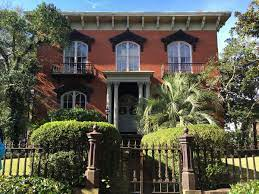
Patrick opened the wrought iron gate and approached the rose-colored mansion between carefully sculpted shrubberies. He was used to encountering ostentatious displays of wealth on his assignments, but this was still intimidating. Mercer House presented an ageless style of opulence, like the rest of this city, curtained behind Palmetto fronds and live oaks dripping with Spanish moss. He felt like he was entering another realm, but then, early morning flights did tend to disorient him. He rang the bell and heard the deep sound echo on the other side of the door. Several minutes passed. Patrick rang the bell again and started to pull up his email to double check that he was here at the right time. As he found the email, he heard footsteps and the door swung open, held by a groggy and irritated-looking man wearing a silky robe, boxers, and fuzzy pink bunny slippers. He seemed to have glitter and lipstick smeared across his face and chest.
“Oh! I’m sorry, I’m just- Mr. Rose should be expecting me-” Patrick stuttered to explain.
“Are you delivering something?” the man drawled, looking blearily down at him. His eyes were red and glassy and his hair was a tangled sandy-colored mop.
“Oh, um, no. I’m Patrick Brewer, with Esquire? I’m meeting Mr. Rose. Are you …an associate.. of his, or...?” Patrick tried to think how he could ask politely to speak to someone sober.
The man’s eyes attempted to focus on him then. “Ohhh, mmm. Esquire, right, how charmingly pedestrian. David mentioned you. And yes, I suppose you could say we’re, ah ... associates .” He leered at Patrick. “I do all of his photography. Among other things. He’s not here, though. Looks like it’s just you and me here at the moment.”
Patrick tried not to visibly cringe at that. Besides the awkward insinuations, he was not happy about the prospect of relying on this person to get photos for his article. Maybe it wasn’t too late to find someone else. Though it sounded like Mr. Rose might insist on this guy if they were somehow involved. Patrick sighed. “Okay. Well. It was nice to meet you …man. Do you happen to know when Mr. Rose will be back?”
“No idea. But, hmmm, I think he said you were staying in the carriage house? That doesn’t seem right, though, for a journalist...”
“Yes, he asked me to stay on site for convenience. Are you, um... Or could you just direct me to the...” Patrick trailed off, looking over his shoulder, not sure where the carriage house was.
The other man groaned a little and turned back behind the door. Patrick leaned in through the entrance, unsure if he was going to come back. Patrick saw him stop at an antique table in the hall and rummage through a drawer. He came back toward Patrick and shoved a key into his hand. “Just follow the path around the left of the house. The apartment’s on the second floor. Maybe try back again after lunch like a civilized person.”
Patrick blinked at him. “Okay, thanks, then. I guess I’ll be seeing you around.”
The other man narrowed his eyes and smirked. “Oh, you will. You look like you’ll be lots of fun to work with at the party. Can’t wait.” With that, he shut the door, and Patrick turned to find his room.
“So, why the Ides of March?” Patrick accepted the cocktail from David’s outstretched hand and let his eyes wander around the simply furnished but beautifully decorated parlor. “Kind of an unexpected theme for the hottest party of the year. Are we celebrating Caesar’s assasination?”
“Mmm, right,” David sighed, looking indignant. “ One man gets killed, and a perfectly benign ancient holiday is overshadowed for millennia. Maybe it’s time we reclaim the Ides from their tragic associations, and instead celebrate their original meaning, as the first full moon of the new year. A night of feasting and drinking to expel the old year and welcome the new.” David took a drink and continued, “And, sure, maybe it’s not a total coincidence that Saint Patrick’s Day is two days later, and this town loses its fucking mind over a five-hour parade and some green beer. It’s worse every year. The whole historic district will be a complete shit show, you’ll see. So I’ll be holding my own festivities before all of that, my own way. And then I’ll be taking off the next day for three weeks in Europe. By the time the green beer starts flowing, I’ll be comfortably on the other side of the Atlantic in Barcelona.”
Patrick pushed aside the dozen more personal questions bubbling up about David’s fixation on an obscure ancient holiday, and his plans in Europe, and instead asked politely about the party’s guest list. As David listed off his connections from the local museum and gallery circles, collectors, professors and board members at the art college, Patrick drifted over to the grand piano in the corner. In his preliminary research for interviewing David Rose, he had seen innumerable photos from social media and other magazine features, read several other interviews he’d given, and still felt completely unprepared for the power the man’s physical presence had over him. He was obviously handsome in his photographs, but in a calculated, aloof way, his face always carefully held in a chilly but smoldering challenge. David Rose in person was twice as smoldering, but with none of the chill. Patrick was finding it difficult to resist being drawn in ever closer to his magnetic energy. He noticed David had stopped talking.
“So, um, your family won’t be attending, then?” he managed.
“My family is certainly not not invited, but they’re not exactly eager to fly in from L.A. for a night of socializing with art snobs, so.” Patrick hid his disappointment that he wouldn’t be meeting the fabled Johnny and Moira Rose. He ran a finger gently across the keys of the old Steinway.
“So, tell me how you came to own Mercer House. This place is a pretty big deal.”
“Is it?”
“I’d say so, it’s one of the biggest homes in Savannah. But everyone knows it as the house built for Johnny Mercer’s grandfather. Legends don’t get much bigger than that around here.”
David wrinkled his nose at that. “I know. It’s all about the name. No one in the Mercer family even lived here.” He looked at Patrick’s hands idly stroking the piano keys. “If you’re such a Johnny Mercer fan, why don’t you play me one of his songs?”
Patrick could hear the teasing challenge in David’s voice and felt a rush. He hadn’t really expected this, but in doing research for this story, he had ended up going down a rabbit hole of Mercer’s music, and had a few in mind. He sat down on the bench and plucked a few notes before launching into a honky tonk Jingle Bells.
“ Oh- kay!” David interrupted, moving to close the lid on his fingers.
“Hey!” Patrick protested. “I didn’t know there was a No Jingle Bells policy!”
“ Ob viously anyone with a fiber of common sense would know it’s incorrect to play that song outside of the annual Chrismukkah party, Patrick.”
“Okay, okay, give me one more chance,” Patrick laughed, and watched David’s affronted facial expression settle back into a skeptical smirk. David was fighting to keep a smile from breaking free, but the crinkles around his eyes told how much he was enjoying this, and Patrick felt warm and a little giddy. They were definitely flirting now, and he wanted to keep teasing David. He turned back to the keys, thinking “Ah, what the hell,” and decided to go for it.
My sugar is so refined
he's got a real high-class mind
he never eats a meal, he dines or he sups
And dogs are little canine friends, they're never pups
he says "banahna" instead of "bananna"
he says "piahno" instead of "pianna"
And you should see how he sits on his settee
With cake and coffee balanced on one knee
My sugar is so refined
he's one o' them high-class kind
he never shares a kiss, he lets our lips unite
But, oh, it feels like kissin' and each kiss is dynamite
I wonder what he thinks of each time I hold him tight
Oh, he's so refined
Patrick finished singing, hoping he had kept his voice steady, the weight of all the changed pronouns hanging between them, and met David’s eyes.
“Well,” David cleared his throat, “that song is also incorrect.” His grin pulled into his left cheek. “But I suppose I could let it slide this once.”
Patrick rose up from the bench, without breaking eye contact. “Oh, really? Well, I suppose -”
He was interrupted by the front door slamming and a clattering from the hall. Both men turned, pulling apart, as a woman in a t-shirt and jeans staggered into the room, carrying multiple heavy garment bags.
“Here’s the clothes you wanted for the party,” she said to David, blowing long, dark hair out of her face and looking suspiciously between them.
“Hi,” she added, acknowledging Patrick.
“This is Patrick Brewer from Esquire,” David said. “He’s doing a piece on the party, so feel free to talk to him about that topic and nothing else, please.”
“I was actually hoping to get a little more background and personal interest than just that,” Patrick chuckled, extending his hand. “Hi, nice to meet you.”
“Mmmhmm,” the woman replied, shaking his hand while looking him over.
“Patrick, this is Stevie. She is an entirely unreliable source of information and a meddler, but I can’t seem to get rid of her.”
She rolled her eyes at him. “I’m his best friend. For some reason.” She turned. “So, Pat-rick. Where are you staying?”
“Oh, David’s put me up in the carriage house. It’s very nice, though you probably know that.” Stevie shot David a look and whispered, “He’s staying here ?”
He gave her an exasperated shrug and said “Actually, Patrick was just asking me boring questions about the house, so. Maybe you could just go hang up those clothes before they become permanently misshapen?”
Stevie smirked and walked over to pour herself a drink, ignoring the request. “Ah yes, the house. Coincidentally, Patrick, I’m the reason David lives in this house at all. If he didn’t already tell you that.” She raised her eyebrows at him.
“No, he didn’t mention that,” Patrick said, smiling at her.
David heaved a sigh and walked over to clean up the mess Stevie had made pouring her drink. “Fine. Yes, I owe Stevie here my eternal gratitude for allowing me to discover her before she got famous.”
“Famous?” Patrick asked, he hoped not rudely. He tried to remember where he might have seen her before but came up blank.
Stevie widened her eyes at him. “You mean you’ve never heard of the Rosebud Snowstorm? Do not Google that, by the way.”
David interjected, “We were classmates at Savannah College of Art and Design. We bonded over our mutual dislike of, well. Stevie, what didn’t we mutually dislike?”
“Hmm,” Stevie mused. “Food.”
“Anyway, Stevie and I collaborated on some performance art pieces that, shall we say, drew attention.”
“The first one to go viral involved me walking into the room in a clay fawn mask, removing my clothes, and breastfeeding members of the audience.” She snorted. “We told people it was a commentary on income inequality. People ate it up.”
“What was it really a commentary on?” Patrick asked, baffled.
Stevie tried to stifle her giggles. “Obviously, it was a multi-layered satire of pretentiousness. An unpeelable onion of sarcasm.”
Patrick could appreciate that. “So under the layers of mockery, is there any real meaning left at the core of your work?”
Stevie raised her eyebrows, looking skeptically at David.
“Nope,” they both said together, laughing. “Other than contempt for the audience. Off the record,” David added.
“Sure, of course,” Patrick agreed. He’d agree to anything at this point, to keep this feeling of being allowed into David’s confidence. This was probably a bad sign for his journalistic objectivity. But how bad could it be for one puff piece on a party? This was fine. He could let himself enjoy this for once.
David continued, “After that, Stevie branched out into absurdist burlesque. Her Oscar the Grouch strip tease was probably her biggest hit.” David shuddered at the thought.
“At one point she was selling out every show and making quite a bit of money. I was able to help her translate that into a collection of ‘found art’ sculptures, featuring props from her shows. Mainly trash, but-”
“Outsider art, David,” Stevie corrected.
“Whatever. SCADians do not produce outsider art. Shock art, maybe. But it was enough to get my foot in the door to collect more, ahem, timeless pieces. Investments. And thanks to some good timing, but mostly my impeccable taste, I eventually turned that into a thriving business. The art sales are what pays the bills, but I’ve found I actually get more enjoyment from doing restorations of damaged and degraded pieces.”
“That sounds like it takes a lot of skill,” Patrick said.
“It’s an art in itself,” David agrees. “The tricky part is removing your own vision and interpretation of what you want the art to be. Seeing with the artists’ eyes, and simply being their hands.”
Stevie snorts, breaking the moment. “Okay, Dalai Lama.”
“I’m impressed,” Patrick says, regarding David thoughtfully. “I would love to see some of your work.”
“Okay,” David said softly, hiding a shy smile in his drink. Patrick felt a happy thrill run through him, like he’d been chosen for a rare honor.
He cleared his throat, feeling Stevie looking at him. “So. What made you two decide to stay in Savannah, rather than, say, New York, or London?”
“Well, part of the reason I came here in the first place was to get out of New York, you know. I can’t stand summers down here, but I really do enjoy the slower pace and community. Not to mention SCAD, obviously. Though the problem with having an art school in a town this size is, there’s an excess of art being created and artists looking for work. The market’s flooded. So, they all leave as soon as they graduate. But for my business, it’s a great opportunity to find emerging talent without all the competition you’d have in a big city. And really, I can close a deal from anywhere; I only rarely need to be present at an auction or sale.”
“And I’m too lazy to move.” Stevie added. “So will someone refill my drink?”
Evening, March 13, carriage house
Patrick sat at his laptop, ostensibly starting his article, idly following synonyms through the thesaurus in search of the right words to describe David. "Stylish" led him to "elegant" to "sophisticated" to …"world weary"? Huh, that was something to consider, though maybe not what he was going for. "Suave" led him to "debonair" (nice) to "dashing," "charming," all falling very short of the essence of the man he was trying to capture. Then, his eye caught on a series of words that struck a chord, not in his journalistic brain, but in a deeper part of him:
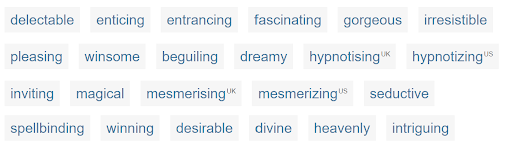
As he whispered the adjectives to himself, trying them on, he felt the ring of rightness pulling at him, felt their meanings shift into something exclusively meant for David, like they could never again be used to describe anything else.
He was shaken from his trance by the muffled sound of music coming from somewhere below him. Scrubbing his hands over his face, he tried to drag his thoughts back to the reason he was here; he wasn't going to be publishing an article on how “delectable” and “spell-binding” he found his host. He couldn't help imagining his agent’s reaction to such an article; Ronnie would gleefully destroy both his dignity and his career. He’d have to just move to another town and find work writing …romance novels, maybe? “Okay, Patrick,” he said under his breath. He couldn't afford to keep losing perspective like this every time he sat down to write, allowing the thought of David to easily veer into fantasy.
Time for a break.
Curious about the faint music, Patrick headed down the stairs from his apartment and stopped at the bottom, noticing a light on through the glass panes in the door to David’s workshop. There he was, in jeans and a black t-shirt, leaning over a long table that stretched across the room. Moving precisely around his space, bending to open a drawer, reaching up to open a cabinet. “Mesmerizing,” Patrick’s brain whispered unhelpfully. “Entrancing.” Any of David’s poise and pretense from their earlier meeting was gone; alone, he was loose and comfortable. Busy with his tools, bouncing a little to the beat, he was clearly in the zone, fully focused on his work. Patrick realized this sight, even from behind and through a warped pane of glass, was one of the most arrestingly beautiful things he had ever witnessed.
As he considered whether to disrupt the scene by knocking, or just head outside for a late-night walk, David turned and squinted at him through the glass. Well, that decided it. Patrick opened the door and slipped in bashfully with a little wave, trying to convey an apology with his body. He raised his eyebrows at the speakers on the wall and David tapped his phone to turn the music down. “Hi,” he said expectantly.
“Hey,” Patrick began. “I was just getting out of my room for a bit and, well, I didn’t want to interrupt you..” he trailed off.
“Oh, no, please,” David cut off his apology. “You are a very welcome interruption. I’m finishing some tedious cleaning work and would love the company. If you’re interested, that is.”
“Very interested. Um, so what are you working on?” Patrick asked, hoping he wasn’t burdening David with his ignorance of art restoration.
“I’m just getting some paintings ready for a show at a gallery I work with,” David said, moving over to uncover something off to one side on an easel. “It’s a Women’s History Month exhibit of contemporary Hispanic painters.”
Feeling at a loss, Patrick grasped for the one name he could relate to this conversational turn, a set of exaggerated eyebrows flashing in his mind. “So, like Frida Kahlo?”
David smiled, looking bemused. “Well, yes, that tends to be what everyone expects. And nothing wrong with that, Kahlo deserves all of that recognition, of course. We’ll have two of her works. But it’s also an opportunity to give some underappreciated artists more exposure.”
“Are you restoring that one?” Patrick asked, pointing to the easel. It held a painting that he thought might be connected to surrealism, but he didn’t want to embarrass himself by asking. There was a checkered floor and a red sky, with pink clouds floating amongst cathedral pillars. Chained to a pillar was a woman with a knife sticking out of her back. It unsettled him the way some Dali paintings did, and he looked away from it back to David.
David continued to look at the painting. “No. This one is about 70 years old, and it’s in decent shape. It wasn’t stored properly, though, and it does need to be cleaned up. But not a full restoration job. It’s called Dolor Reumatico, Rheumatic Pain , by Remedios Varo.”
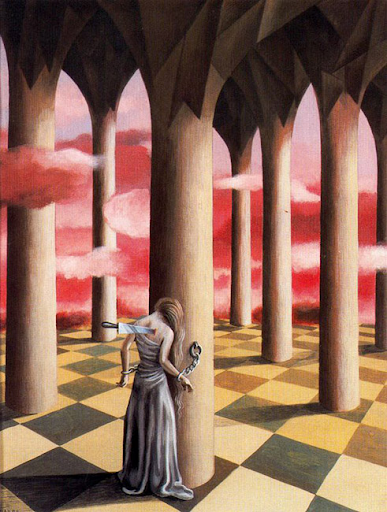
“I can certainly see the pain there,” Patrick ventured, feeling way out of his depth. “Is this … Surrealism, then? It feels like something from a dream.”
David smiled at him then. “That’s right. Dream imagery featured prominently in Surrealism. It was a way to bridge the unconscious and conscious minds. Varo was part of the Surrealist scene in Paris and then Mexico, but she struggled to be taken seriously as an artist in the insular, misogynistic art circles of the time, where men saw women primarily as objects or muses. The pain in this piece is likely about that experience of oppression by the culture around her. She left a rigidly religious family to find the freedom to pursue artistic expression in Paris, only to find herself one again at the bottom of a repressive hierarchy that restricted her freedom to explore her identity and art. Suffering in isolation. No matter how far you go, you can’t leave that behind.”
As David trailed off, Patrick thought he heard a slight hitch in his voice and his eyes seemed focused, not on the painting, but somewhere far away. Patrick hesitantly moved his hand up to rest on David’s shoulder, needing to touch him. The initial sense of dread he’d felt from the painting had dissipated with David’s explanation, leaving sadness.
“You know, I guess I usually think of loneliness as a kind of general dull ache,” Patrick quietly ventured. “When I just don’t like being alone. But here it’s a very specific, acute kind of agony. With a knife-wielding perpetrator.”
“It’s both,” David said softly, bringing his hand up to cover Patrick’s on his shoulder. “It’s a general aching loneliness, but also a very specific, echoing absence.” David turned to look at him then, causing Patrick’s right arm on his shoulder to partly wrap around him. Their eyes found each other and Patrick drew in his breath at the intensity in David’s eyes, the longing. They were so close, David practically in his arms. David’s left hand found Patrick’s fingers by his hip. Patrick felt his head tilting slightly as he leaned in, eyes swimming with hunger.
Later, Patrick would relive that moment again and again, unable to determine with absolute certainty if the faint brush of lips he felt was real or his imagination. His lips were sure about the heat, the breath, the electric sparks flying between them. His body was sure about the way they pulled toward each other, hands tightening, just before the gunshots outside broke the spell, both of them jumping and David screaming in shock.