
Chapter Text
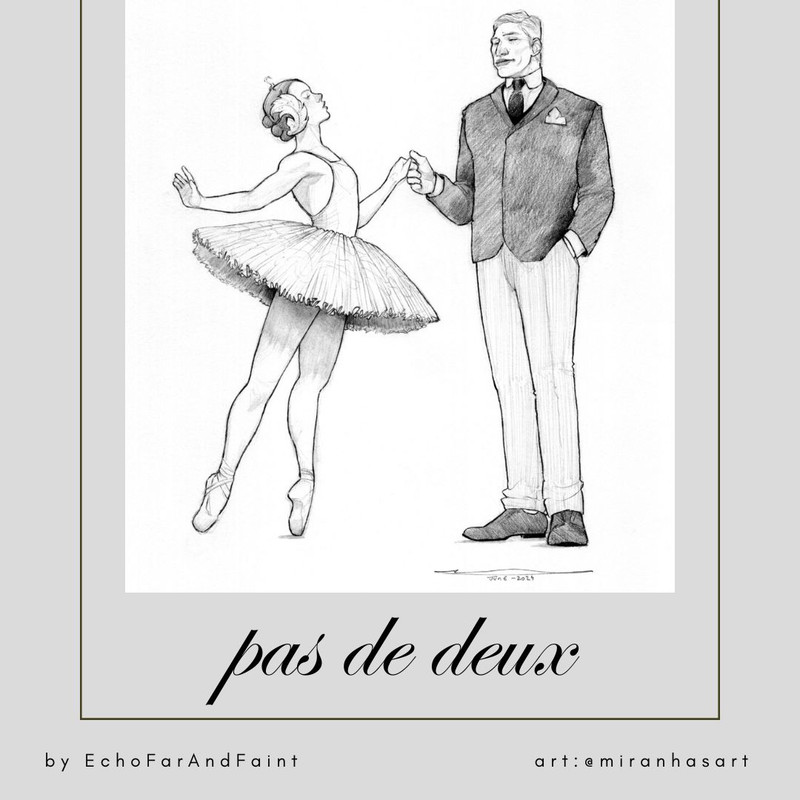
A bouquet of white lilies at the stage door again. No note attached and no need for one. Rey knew who they were from.
Enzo Ferrari.
A name so well-known in Modena that it required no calling card. No explanation. A man almost as famous as God, and perhaps more important in this town.
The cramped stage door of The Teatro Comunale di Modena was watched over suspiciously by Guiseppe, a bad-tempered mustachioed man whose job was to keep the ballerinas in and the riff-raff out.
“For you, signorina ,” he said, gesturing at the flowers, one ear pressed against the rotary phone, the cord twirled in his fingers.
Rey picked up the bouquet with her free hand, the other curled protectively around the heavy shoulder bag that contained all her worldly goods (three pairs of pointe shoes, two pairs of ballet flats, a repair kit for both kinds of shoe, band aids, toe dividers, two pairs of tights and two leotards, two practice skirts – one short and one long – hair ties, hair brush, cosmetic bag, baby powder, an apple, a banana, four squares of dark chocolate, a large canteen of water.) “Can I borrow a pen?”
Guiseppe nodded dismissively. Rey plucked the thick cream card from between the blooms. Rey Niima. She flipped it over and scribbled a note on the back.
“Give this to him if he comes back,” she said, sliding it across the worn wooden counter. “Grazie.”
*
Rey was not surprised il Commendatore had left her flowers again. He had been doing it every week since the show opened, much to the whispered amusement of Kaydel and Rose, who sometimes peered out of the upstairs window during rehearsal to watch him draw up outside the stage door in his silver car.
Rey never looked.
He wasn’t her first devoted admirer. There had been a few at La Scala. And before that, too, even when she was training and danced in the student shows at the Royal Ballet School in London. Men who waited in the winter air of Covent Garden, holding out black and white headshots for her to sign. Always something surreptitious in their eagerness. Something unsettling.
But Rey didn’t dance for men. In fact, she didn’t dance for anyone. She’d realized that long ago, watching the other children’s faces light up when their parents arrived at recitals, programs clutched in their hands, waving up at the stage. No one came to watch her, and she never cried about it. She never refused to go on. If anything, she danced even harder.
She had no guaranteed praise from an adoring mother and father, relying instead on the sparse approval of Madame Kanata, a Russian emigre who had trained with the Bolshoi in Moscow and brooked no misbehavior. A pursed smile from Madame was as good as Rey could get, and she took it greedily.
Practiced harder. Longer. Pushed herself further.
It was that work ethic that made her the youngest graduate of the Royal Ballet School. A company member at La Scala at the tender age of seventeen. The most promising dancer of her generation (according to Luca, the old ballet Master in Milan, who hit her shoulders with a ruler to make her relax them and once cried watching her perform Gamzatti in ‘La Bayadere.’)
Until the pain in her foot. The pain she ignored. That she pushed through because she was the Sugar Plum Fairy in La Scala’s Nutcracker and she refused to give up the solo to any other dancer.
The company doctor treated her with numbing injections, even while shaking his head, even while begging her to reconsider. The pain became so intense that as Rey danced off stage one night the ropes, pulleys and thick red curtains backstage swam before her eyes and she awoke two days later in a hospital bed. It was broken. She needed surgery.
Career-ending, they’d said.
Well, it hadn’t been.
Four weeks later, Rey was back in rehearsal. But she had been replaced regardless.
The new principal was younger, smaller and more beautiful than her. A real Italian with dark hair and no freckles. A technically perfect dancer, perhaps, Luca had told Rey miserably, but lacking passion. It wasn’t his choice to let her go, he’d said.
And then there was Modena.
It was not London or Milan. It was not the place she’d dreamed of dancing as a child, alone in the ballet school dorm rooms with no home to go to for the weekend. But she could not be defeated by adversity. That was the thing about starting with nothing. There was no cruelty life could throw at Rey that she could not withstand. Her real gift was tenacity.
Rey left the flowers on her dressing room table. She didn’t put them in water. There was only an hour to warm-up at the barre before a three hour rehearsal, and then ‘Romeo and Juliet’ in the evening. She checked her bun in the mirror, smoothing down the fly-away hairs.
He would be there watching, she knew. Ferrari had a private box and a season ticket. Yet another luxury for a man treated like a king whose Midas touch turned cars into gold.
Rey met her own eyes in the mirror, and saw the steel there. She would not be bought and sold.
If you aren’t a coward , she’d written on the note at the stage door, deliver them yourself.
*
“You have a visitor, signorina .” Guiseppe said sheepishly the following evening as Rey rushed in. She had been in a mad dash to get coffee and a sandwich from the panetteria on the corner in between rehearsal and makeup. She was still in her practice leotard and leggings, sweaty from dancing all afternoon.
“What do you mean?” She stopped short, out of breath. Visitors were not permitted backstage unless they were chaperoned members of the press. “Where?”
Guiseppe glanced down at his hands. “I told him to wait in your dressing room.” Rey swallowed and glanced down the hallway, clutching the paper bag of still-warm bread to her chest. “I’m sorry, signorina, but I could not say no.”
Rey nodded. She imagined her hair being pulled up as if attached to a string. Let her spine straighten and settle. There was nothing to be afraid of. He was just another man, in the end.
Like all men, he wanted a performance.
She would give him one.
*
Rey expected him to be sitting, but instead he was leaning against the door frame, sunglasses still on. A new bouquet of yellow flowers lay abandoned on her dressing table. Enzo Ferrari wore an expensive gray woolen suit and seemed larger, up close. She wondered how long he’d been there.
“ Commendatore .” Rey’s knees wanted to curtsy, but she didn’t let them.
“Please,” he said, in deep accented English that made the baby hairs on the back of her neck stand up, “call me Enzo.”
She laid the brown paper bag and coffee cup down next to the flowers, hoping he wouldn’t notice that her hands were trembling. (What was this? Stage-fright, after all these years?)
“I am not sure why you’re here,” Rey said lightly. She glanced up and saw the corner of Enzo’s mouth curl into a rueful smile. He reached up and removed his glasses, tucking them into the breast pocket of his suit jacket.
“You asked me to come,” he said. “You wanted me to show you I’m not a coward.”
“Well, now you’ve shown me,” Rey said with what she hoped was an air of finality. “But, if you’ll excuse me, I have to get ready for the performance tonight.”
She busied herself at her dressing table as though he was already gone, laying out the makeup she would need. (Thick matte foundation to combat the shine, eyeliner, false lashes, mascara, nude lipstick, powder and cold cream to take it all off again.)
The same routine every night. But normally she went over to the sink in the corner, stripped off her practice clothes and washed the film of sweat off her skin with a cloth before putting on her costume.
But Enzo did not leave. He just stood very still, watching her.
“Is your name short for something?” he asked.
“What?” She was getting irritated. This man might be a titan in Modena, but at that moment he was just a large obstacle in her dressing room.
“Rey. Is it short for something?”
“No.” She slid into the chair, and started undoing her practice braid and combing out her hair. She hadn’t washed it in a few days, which was ideal. It was greasy and well-behaved. Far from beautiful, but easy to smooth and flatten into the perfect bun. She could still see him, reflected in the mirror behind her.
“Un raggio di sole,” he said softly. Then: “It’s… unusual. It’s the name your parents gave you?”
Rey pursed her lips as she slipped in a bobby pin. “I wouldn’t know. It’s the only name I have.”
Enzo sucked in a breath and frowned, as if aware he’d misstepped. “Ah, yes. I have read the newspaper articles about you,” he said carefully. “The tragic prima ballerina. From humble beginnings a star has risen.”
Rey laughed flatly. “Do you believe everything you read in the papers? They print stories about you too. Your cars.” She paused. “And your women.”
“Not everything they write is true,” he said kindly, as if explaining gravity to a child.
But Rey had had enough. He’d proved his point. He’d taken up enough of her time. She could call down the hall to Guiseppe and have politely escorted away. And yet, it didn’t stop her turning in her chair and asking the questions.
“Do you even like ballet?” Their eyes met for the first time, and she stumbled for a second. But she pushed forward. “Your box. Do you sit there because you appreciate the dance? Or just to be seen to appreciate it?”
“I appreciate the passion,” he said. “And the craft.”
“You come to watch the craft?”
He smiled again, lines at his eyes and mouth softening his face.
“No,” Enzo said. “I come to watch you.” Then, more softly: “ Only to watch you.”
Ah. Here they were at last, the unspoken question between them caught in the air like a dancer frozen mid-jeté. Suddenly, Rey felt afraid.
“Well, thank you for the flowers,” she said, turning back to her reflection. “I need to get ready now.”
“Rey —” He said her name like it belonged to him.
“I think you know the way out —”
She pushed away the fear, and let it become something she could use. Anger.
“Rey —”
“No!” She threw the makeup brush down onto the table and turned back towards him. “You cannot buy me with flowers. Or attention. Or money. I’m not for sale.”
“I don’t want to buy you, cara ,” he admonished.
“Then what do you want?”
“I want to have you,” Enzo said, as though it was the most obvious thing in the world. “But I don’t want to own you.”
*
He left because all men left. He slipped slowly out of the door and down the hall, leaving his flowers behind him and Rey didn’t watch him go.
They all leave in the end . Rey was only twenty-five but she had learned that lesson long ago. It started with Pauli, the stage manager at La Scala, who had sworn on the grave of his dead mother that he would love her forever, but didn’t hesitate to sleep with her understudy. Or maybe it was the danseurs in her graduating class at ballet school. Young men who held her with firm and steady hands during an overhead lift but didn’t remember her birthday, let alone get her a present, even when she warmed their single beds.
Or perhaps it was before that. Perhaps it had started with her father, who clearly had not loved her enough to keep her.
All men left. That was one of the universe’s unbendable rules.
Or at least, Rey believed that, until Enzo Ferrari.
*