Chapter Text
The cathedral bell tolled five times, and Nero finally forced himself awake. In Fortuna, lingering in bed was not done. An old servant knocked while the youth dressed hastily, then brought in a basin of water. As always, it was ice-cold, unheated, and came with a rough towel.
Nero snorted, trying to suppress the unpleasant sensations. Taking a clean rag, he scooped up a white paste of chalk, eager to clean his teeth as quickly as possible and be done with the disagreeable ritual.
He dressed plainly; common soldiers could not afford much. Besides, he had no wish to attract unnecessary attention. The same elderly servant brought a tray with his meal: a piece of stale bread, a bowl of barley porridge, washed down with watered wine. Next came prayers, which Nero always gladly skipped.
Nero was happy to spend a little more time in his room. The Order’s knights had a simple schedule: rising, a communal breakfast where people always stared and whispered behind his back, prayers and sermons, then training.
Instead of the hour-long prayer, Nero preferred to sleep a little longer or to read. It was no great matter, but if anyone caught him idly wandering during prayer hour, he would be forced to attend daily, from the crack of dawn, without breakfast or washing. The boy had made that mistake once as a child and had no intention of repeating it.
The bell tolled seven times, and Nero ran to the training ground. The practice yard was gradually filling with youths like himself. An old veteran was waiting for them all, and the moment he saw they had gathered, he drove them on.
Each took up sword and shield at a single command. Nero hacked at the dummies until sweat blurred his vision, and he did it without the useless shield—it would have been far better. They were training to kill demons, and a shield could only save you from a single blow before splitting at least in two.
Next came horsemanship, as the stable hands proudly called it. The whole troop groomed horses, cleared dung, saddled mounts, and only a select few—bastards—were allowed to ride. Nero was among them and considered it the best part of his training. The horse bore him across the field, pulling away from the rest, and that was the moment when the sea breeze felt especially pleasant.
But all good things must end. After training came a brief lunch, surrounded by comrades who never held their tongues. Nero always felt an outsider and tried not to be drawn into conversation, for it often led to talk of his white hair—whether cursed or blessed. And recently, a bandaged arm had been added to it, beneath which demonic scales lay hidden. Still, the youth found it pleasant to stave off boredom with a good piece of game, cheese, or fresh bread.
Nero was assigned to guard duty. He did not understand why, three days in a row, he was posted at the very same spot. He felt he might die of boredom, standing rigidly at attention by the church, when Credo called him over.
The general, who was also his elder brother, was a confidant of the governor. Many considered that luck, but Nero knew of his brother’s diligence and did not hesitate to take advantage of his high station.
“Credo!” the youth hissed. “You promised you wouldn’t put me on guard duty!”
“I promised nothing,” the general replied, clad in his ceremonial attire. “And I’m here on business. The governor summons you.”
Nero’s brows rose in surprise.
“Have you heard the rumours?”
“Which ones?”
“An important aristocrat from a ducal house is coming to us.”
“I think I have…”
“The youngest son of Sparda himself,” Credo continued, lowering his voice. “The governor wants you to take part in the reception.”
“Me? Why?”
Credo gave him a long, searching look.
“I don’t know,” he said at last. “But the governor received a letter from the duchy. With Sparda’s personal seal. And after that letter, your name appeared on the guest list. You know I don’t meddle in such matters.”
Nero was silent, digesting the news.
“Come.” Credo touched his shoulder. “Don’t keep the governor waiting.”
On the way to the governor’s tower, Nero tried to make sense of it. Why did the duke’s son need him there? Perhaps it was some sort of test? Or maybe they simply wanted all of Fortuna’s young warriors to line up before an important guest? He did not know.
“Credo,” he could not help himself. “Do you know anything about this aristocrat?”
Credo smirked. “They say a lot about him. That he is a madman and a debauchee. That he lost a fortune at dice and seduced a hundred women. That his father disowned him and keeps him at court only out of charity.”
“So he is… a bad man?”
“I don’t know. But they also say the peasants consider him a hero. And that wherever he appears, demons vanish. So judge for yourself.”
Nero did not know what to think. But his heart beat faster than usual, as if sensing something important. It was no coincidence they had given him the best uniform and scrubbed him up, as if trying to turn a yard dog into a noble breed. He felt absurd, but he did not argue.
All of Fortuna’s high society had gathered in the central church for one purpose: to welcome and behold the son of Sparda. Even if he did not possess a remotely acceptable reputation, everyone awaited his appearance.
The incense was thicker than usual. Young soldiers stood in a row. Nero would have fled if he’d had an excuse, and if Kyrie’s singing had not compelled him to stay. Her voice was the only thing that graced this church—until the sound of hooves was heard.
Nero turned, hearing a strange noise, much like the one he often made when kicking down doors.
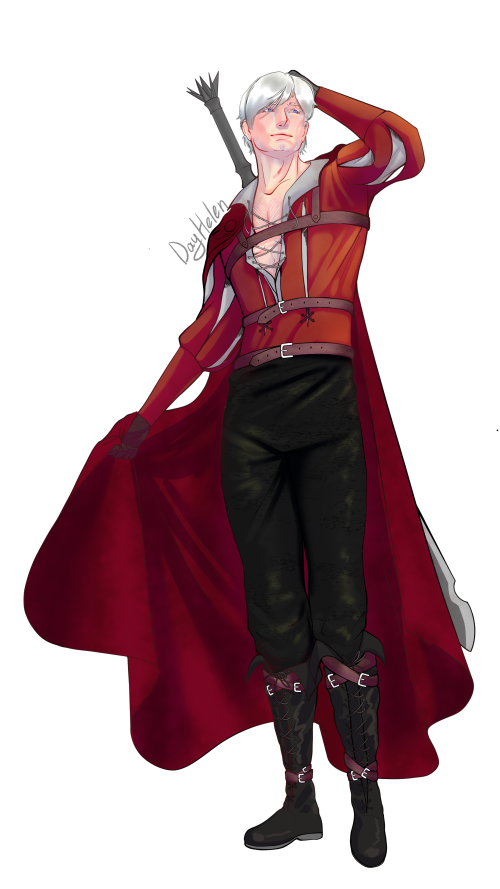
The church doors burst open with such a crash that the old stained-glass windows whined piteously, and there on the threshold stood a horse. Huge, chestnut, nostrils flaring, mane streaming like flame. Upon it sat a rider in a scarlet cloak; his clothes did not seem rich, but their quality proclaimed the rider was no common vagabond.
He wore white hair, which Nero did not immediately notice, falling almost to his shoulders. Goosebumps ran down Nero’s skin; that mad, insolent, merry smile unsettled him.
“Forgive my lateness,” said the rider, not even thinking of dismounting. “I got lost and lost track of time while dealing with demons.”
The governor leapt to his feet, reddening. “What is the meaning of this?! Into God’s temple—on horseback?! This is sacrilege!”
The son of Sparda—Nero no longer had any doubt—leapt off his horse as lightly as a cat. The horse snorted but remained standing, blocking the exit.
He stepped inside, paying no heed to the governor, and the crowd parted before him like water. Nero saw that a heavy sword was slung across his back. No one in Fortuna bore weapons in church—it was considered sacrilege—but the youth was more disconcerted that such a huge sword was carried on the back. Who even does that?
“Well, where is this little fledgling?” Dante asked, scanning the faces. “I know he’s here. My…” He stopped. His eyes found Nero. For a moment, silence hung in the church. Dante looked at Nero, Nero looked at Dante, and something strange passed through the air between them. Nero felt his left hand, hidden under bandages, begin to itch, as if reacting to this man’s presence.
“Aha,” Dante said quietly, almost to himself. He moved toward Nero, ignoring the guards who uncertainly barred his way.
Nero was dumbfounded. He barely managed to grab something heavy before parrying a thrust. The stranger was terrifyingly fast; the guards had no time to react, but after this assault the governor recovered from his shock.
“This is outrageous! Guards! Seize him!” shouted the governor, hastily fleeing the dais. Two guards rushed at Dante. He did not even turn. He merely waved a hand, and both flew aside, crashing into the pews.
“I don’t want to cripple anyone,” Dante said, still looking at Nero, who realized he was holding a floor candelabra. “I just want to play with someone I haven’t seen in a long time. Or are you a coward?”
Nero felt blood rush to his face. He already knew he would fight.
“Nero, no!” Credo shouted, drawing his own sword to oppose the stranger, but it was too late.
“I have no weapon,” Nero said, when a fine bastard sword of excellent steel clattered at his feet.
“Catch. This will do.”
Nero caught the sword; it sat well in his hand. Looking up, he realized his opponent was already flying at him. Nero managed to block this lunge too; he needed distance, otherwise he risked ending up right on the blade.
People fled. No one wanted to be caught between two fires, so within a minute the hall was empty. Only the clash of swords filled the church. Nero understood he was being toyed with, like a puppy, so he could not lose so easily.
Nero blocked thrust after thrust and tried to answer in kind. The borrowed sword did not suit him nearly so well as his own Red Queen. That blade had been forged especially for him, as all others became useless within a couple of months.
Nero was strong, unusually so, which irritated all his comrades. And this madman deflected everything and everyone, as if Nero were nothing more than a bug.
“Wider stance,” Dante said calmly. “Feet shoulder-width apart, or you’ll fall. And don’t swing like a woodcutter. The sword is an extension of your arm, not an axe.”
Nero was breathing hard. Dante hadn’t even broken a sweat.
“Who the hell are you?!” Nero gasped.
“Your very best teacher!” Dante smirked.
Nero charged again. This time he tried to deceive his opponent with a feint, but Dante parried effortlessly, pushed the blade aside, and flicked Nero on the forehead with the fingers of his free hand. It was mockery.
Nero clenched his teeth and attacked again, pouring all his anger into the blow. The sword whistled, aiming for the head, but Dante ducked, letting the blade pass over him, and in the same movement swept Nero’s legs from under him. He crashed to the floor, dropping the weapon.
“Better already!” Dante said, looming over him. “You’re angry. That’s good. But anger should work for you, not cloud your eyes!”
Nero scrambled up, picked up the sword. In his left hand, hidden beneath the bandages, something suddenly ached, itched. He involuntarily clenched his fist, and the bandages tightened, began to tear.
Dante noticed. His eyes glittered.
“Whoa,” he said quietly. “Now that’s interesting.”
“What?” Nero didn’t understand.
“Your hand. Show me.”
Nero instinctively hid his left hand behind his back. It had appeared only a month ago, and he already hated it. More proof of his otherness. Another reason for mockery. He did not want this.
“None of your business!” the youth snarled and lunged at Dante, forgetting the sword. He just wanted to hit, to tear that insolent face.
His left hand shot forward of its own accord, the bandages burst, and Nero felt his fingers close around something solid. He grabbed Dante by the collar and, not comprehending his own strength, hurled him several meters.
Dante landed on his feet like a cat and burst out laughing.
Nero stared at his left hand. It glowed with a faint blue light, the fingers twitched slightly, but they felt extraordinary strength. He could crush a stone to dust with this hand.
Nero hesitated; he did not want to use it on a person, but adrenaline boiled in his blood. He lunged at Dante, thrusting the hand forward. His fingers closed on empty air—Dante had sidestepped again.
“Faster, kid!” he shouted. “You can be faster!”
Nero spun, snatched again, but Dante caught his wrist and, using the momentum, spun Nero around like a top.
“At this rate you won’t even catch a gnat!”
Nero snarled. All the pain, all the loneliness, all the years of humiliation erupted in one swift rush.
And then Nero did something he did not expect of himself. Instead of slashing, he whirled around and kicked a heavy wooden pew with all his might, sending it straight at Dante. He lazily dodged, but the pew smashed into the statue of the Saviour standing in the center of the church, and it creaked piteously.
“Hey, careful with the holy objects!” Dante called, but there was merriment in his voice.
Without thinking, Nero grabbed a candlestick that came to hand and hurled it at Dante. He deflected it with his sword, but Nero was already charging at him, fatigue forgotten. The hand now glowed.
Dante noticed. His eyes gleamed.
“Whoa. Now that’s interesting.”
He stopped evading and went on the counterattack. Their swords crossed, and Nero suddenly understood that Dante was not just stronger—he was many times faster, more experienced, more skilful. Every strike was precise, every movement measured. Nero fell back, gasping, realizing he was losing.
But he had no intention of surrendering. In desperation he grabbed Dante’s arm, trying to disarm him. Nero would not let go. He felt power flowing into his hand, his fingers clenching of their own accord. Dante broke free, but Nero seized the moment, grabbed him by the cloak, and flung him straight into the statue of the Saviour.
The crash was deafening. The statue, which had stood in the church for many a century, shattered into pieces with a dreadful crack. Stone shards sprayed in all directions, raising a cloud of dust. Dante vanished into that cloud.
The church fell silent. Only the dust slowly settled on the floor.
Nero stood, breathing heavily, staring at the pile of stones under which his opponent should have been lying. His hand burned like fire, the bandages completely undone.
“Nero…” came Credo’s voice from behind, more surprised than angry. He had been evacuating the townsfolk and had not expected to see such devastation. “What…?”
But Nero did not listen. He stared at the statue’s ruins and waited. Waited for Dante not to rise. Waited for it all to be over.
Then the stones stirred.
A gloved hand emerged from under the rubble, hurling aside a large chunk, then another. Dante rose, brushing dust from his cloak. There was no anger on his face. Only a strange, almost proud expression.
“Well, now,” he said, working his shoulder. “You nearly broke my arm. And smashed the statue. Beautiful.”
He stepped toward Nero. Disbelieving his eyes, Nero raised his sword, but Dante knocked it aside with a single motion, and the blade flew into a corner. The next blow struck Nero in the jaw—he reeled but remained standing. Dante hit him again, and Nero crashed to his knees.
“Enough,” Dante said, drawing back his fist for a final blow. “You did good. Truly. But I need you to sleep a little.”
The fist fell on the back of Nero’s head, and the world went out.
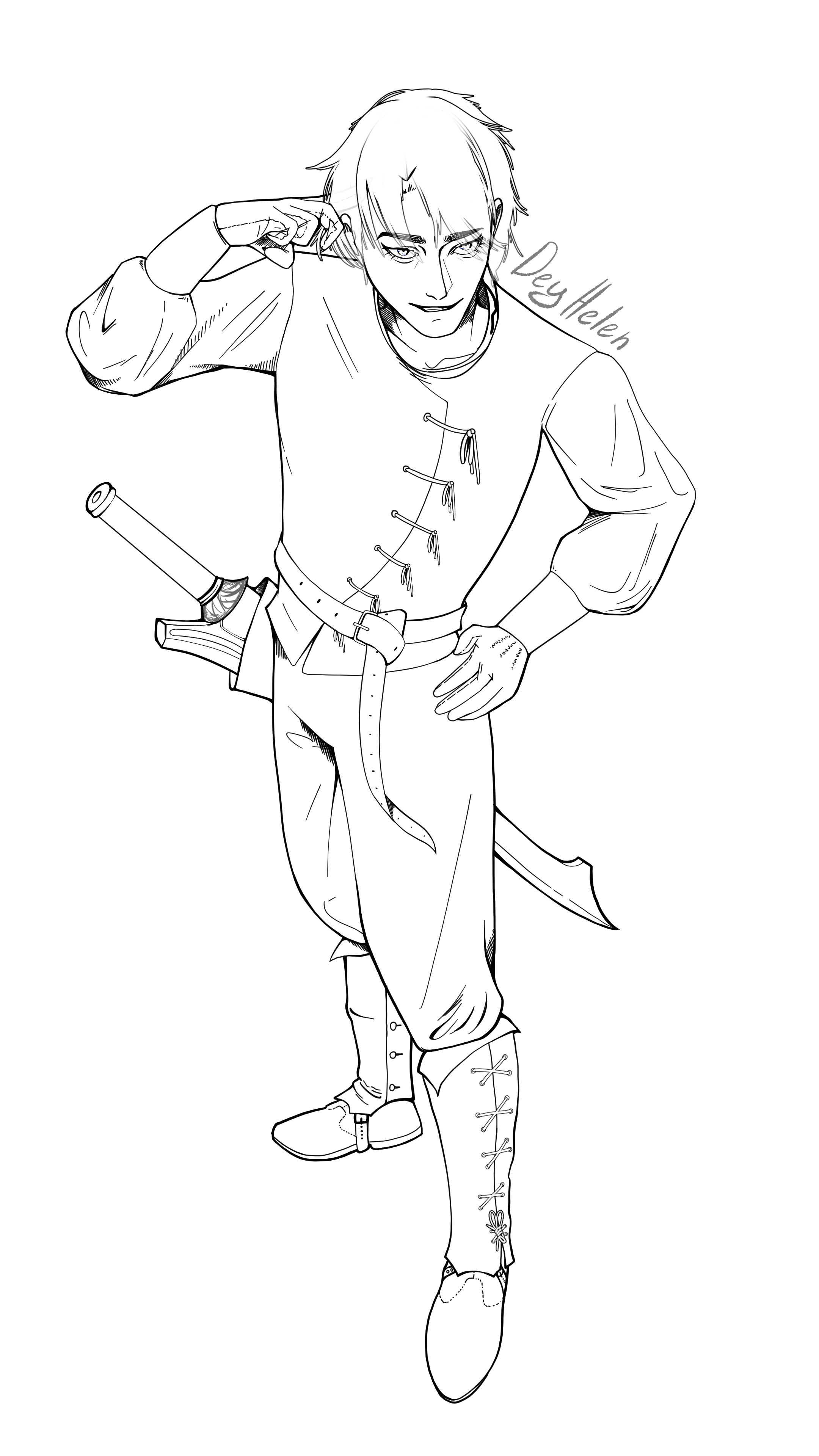
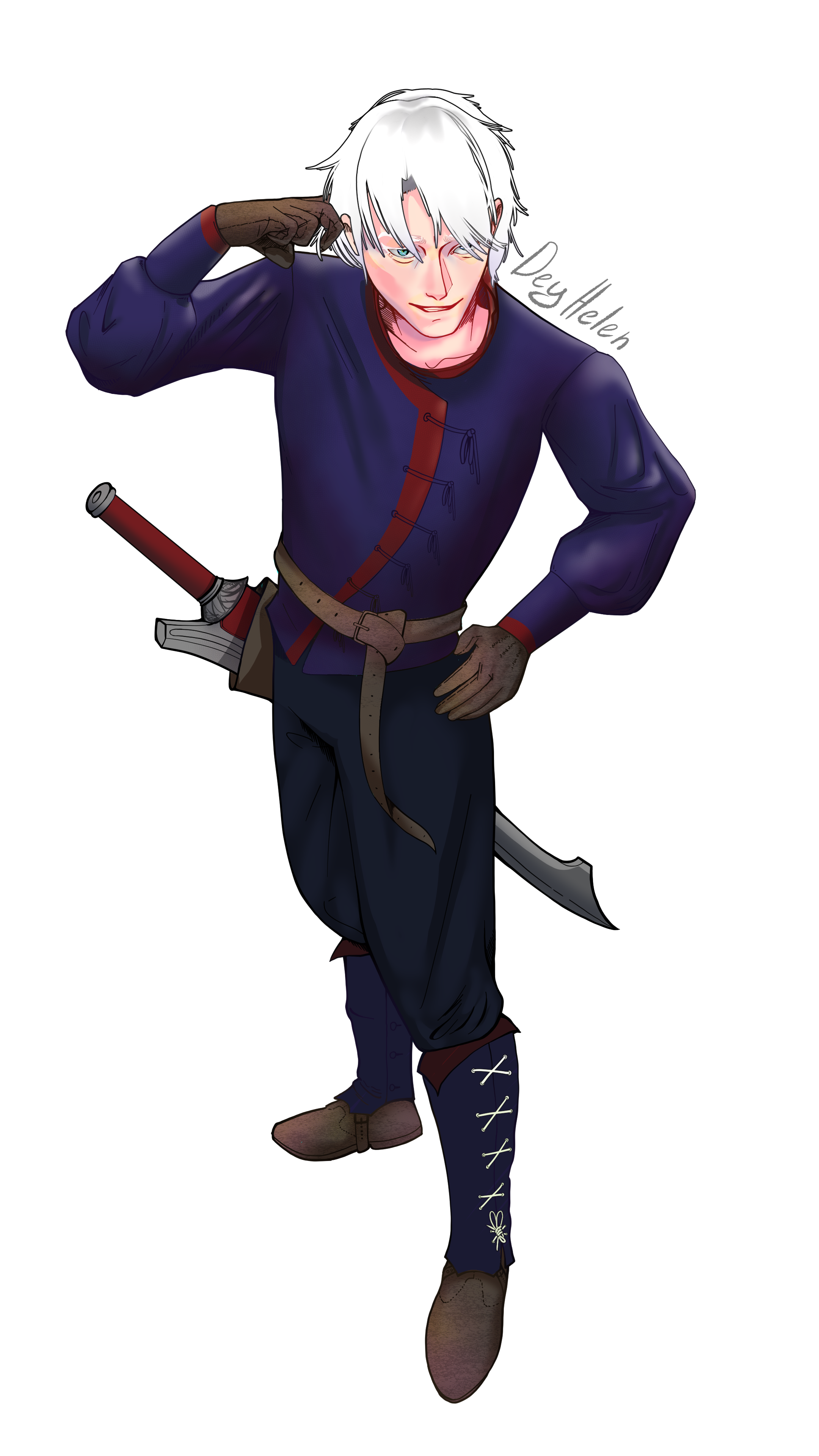
Nero art:
Dante art: ***